Flying a Drone in Vietnam: 2026–2027 Guide & Regulations
Planning to bring a drone to Vietnam in 2026–2027? Read our updated guide on permits, sub-250g rules, no-fly zones, customs, and aerial photography logistics.

From the emerald limestone karsts of Ha Long Bay and Ninh Binh to the sculpted rice terraces of Mu Cang Chai, Vietnam is a dreamscape from above. However, the country enforces some of the strictest airspace and national security regulations in Southeast Asia—updated further for 2026 and 2027.
If you are an international photographer planning to pack a drone—or rent one on location—understanding the exact legal rules for foreign nationals, mandatory local military and police coordination, no-fly zones, and real-world enforcement cases is critical before you ever power on your propellers.
Foreign visitors cannot apply independently; every permit requires a licensed Vietnamese sponsor or tour operator.
Requires MND flight permit, valid drone pilot certificate, and on-site flight coordination with local police and military commands.
Joint police and military tracking in red zones; severe violations lead to confiscation, heavy fines, or criminal prosecution.
1. Rules for Foreign Photographers, Pilot Licenses & Local Coordination
Vietnam regulates all unmanned aerial vehicles (UAVs) under the 2024 Law on People’s Air Defense and Decree 288/2025/ND-CP, alongside stricter civil aviation security rules effective July 2026.
For foreign photographers and international travelers, flying legally in Vietnam requires satisfying three distinct legal pillars:
Specific Rule for Foreign Photographers
Under Vietnamese defense regulations, foreign nationals are not permitted to apply for drone flight permits independently. Any permit application for a foreign photographer must be formally sponsored, guaranteed, and supervised by a licensed Vietnamese organization or registered tour operator.
-
1. Ministry of National Defence Flight Permit & Drone Pilot Certificate: Beyond aircraft registration and an advance flight permit from the Operations Department of the General Staff (applied 2 to 4 weeks ahead), operators must also hold a valid UAV Pilot Certificate (Class A for 0.25 kg to under 2 kg; Class B for 2 kg and above, or recognized equivalent qualification). Sub-250g recreational drones are exempt from formal flight permits only in open rural zones outside all prohibited/restricted areas.
-
2. Mandatory Pre-Flight Local Coordination (Hiệp đồng bay): Holding a central Ministry of Defence permit alone is not enough to launch. Before every flight session, the operator or sponsoring tour leader must report directly to the local Ward/Commune Police (Công an địa phương) and the local Military Command (Ban Chỉ huy Quân sự địa phương) to verify exact takeoff times, altitude limits, and GPS boundaries.

2. Official Airspace Map (cambay.mod.gov.vn) & Absolute No-Fly Zones
Before launching any drone—regardless of weight—pilots must check Vietnam’s official Ministry of National Defence airspace portal at cambay.mod.gov.vn, which displays color-coded restriction layers across the country:
How to Read cambay.mod.gov.vn
Airports, military bases, government headquarters, central urban cores, islands, and sensitive border corridors. No recreational flying is permitted under any circumstances.
Buffer zones around civil aerodromes, industrial hubs, and designated scenic or border areas requiring explicit advance clearance, local military coordination, and altitude caps.
Rural valleys and agricultural landscapes where sub-250g recreational drones or permitted flights may operate, subject to local authority and community rules.
Locations Where Drone Flying Is Strictly Prohibited
Unless covered by rare, special-purpose defense and site clearances, flying a drone is strictly forbidden in all of the following areas:
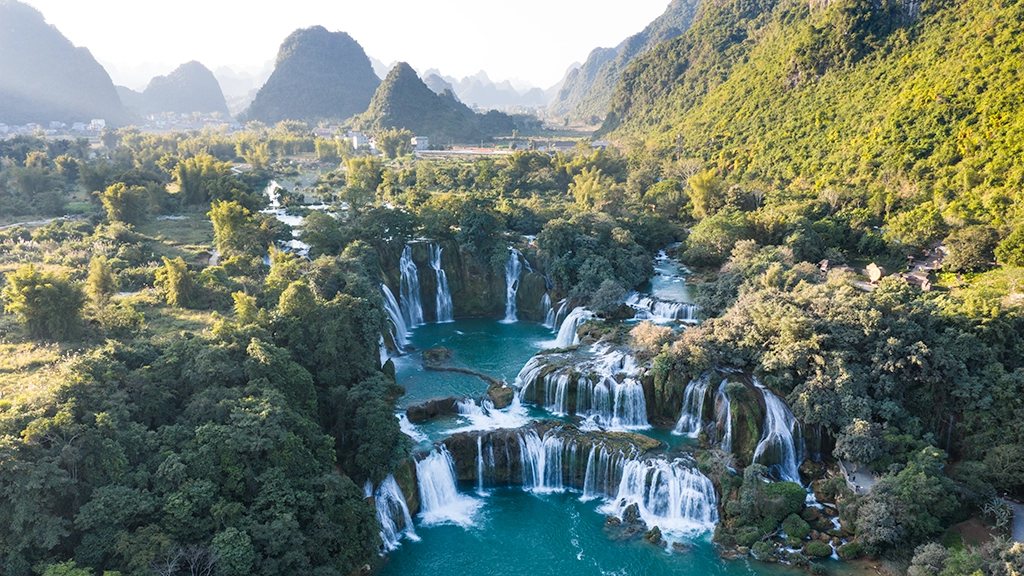
Strictly prohibited within 25 km of the China land border (affecting Ha Giang, Cao Bang, Lao Cai/Sapa), 10 km of the Laos and Cambodia borders, and across all coastal islands and archipelagos (including Phu Quoc, Con Dao, Cat Ba, and Ly Son defense zones). At cross-border landmarks like Ban Gioc Waterfall (Cao Bang), drone management is strictly enforced and requires formal authorization from both Vietnamese and Chinese Border Guard authorities.
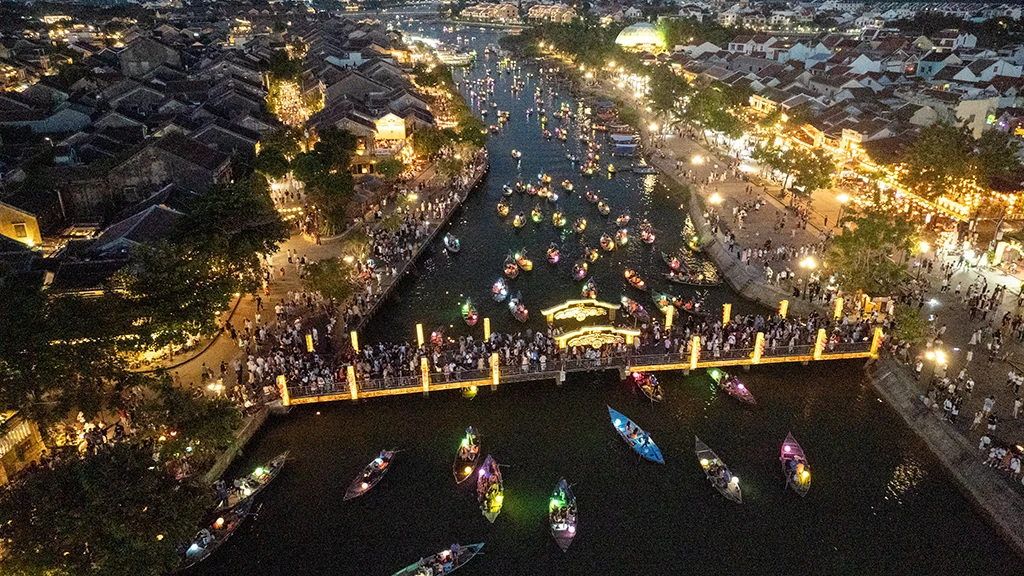
Strictly prohibited inside UNESCO World Heritage Sites (Hoi An Ancient Town, Ha Long Bay, Trang An/Ninh Binh, Hue Imperial Citadel, My Son Sanctuary) and National Parks (Cuc Phuong, Phong Nha-Ke Bang, Ba Be, Cat Tien) without specialized permits. Hoi An Ancient Town is now designated a strict red zone where unauthorized drones are banned—numerous visitors have been intercepted, arrested, and fined for launching over the Old Town.
Never fly near state and government headquarters, Communist Party offices, police stations, border guard posts, or military barracks and training grounds—even in small rural towns.
Prohibited within a 15 km × 5 km runway corridor around all airports and strictly forbidden directly over crowds, festivals, markets, or public gatherings where equipment failure poses a safety hazard.
3. Real-World Enforcement: Recent Red-Zone Cases in the News
Vietnamese authorities actively monitor airspace using radar, RF drone-detection systems, and rapid-response patrols. High-profile incidents disrupting commercial aviation have triggered nationwide crackdowns across major cities:
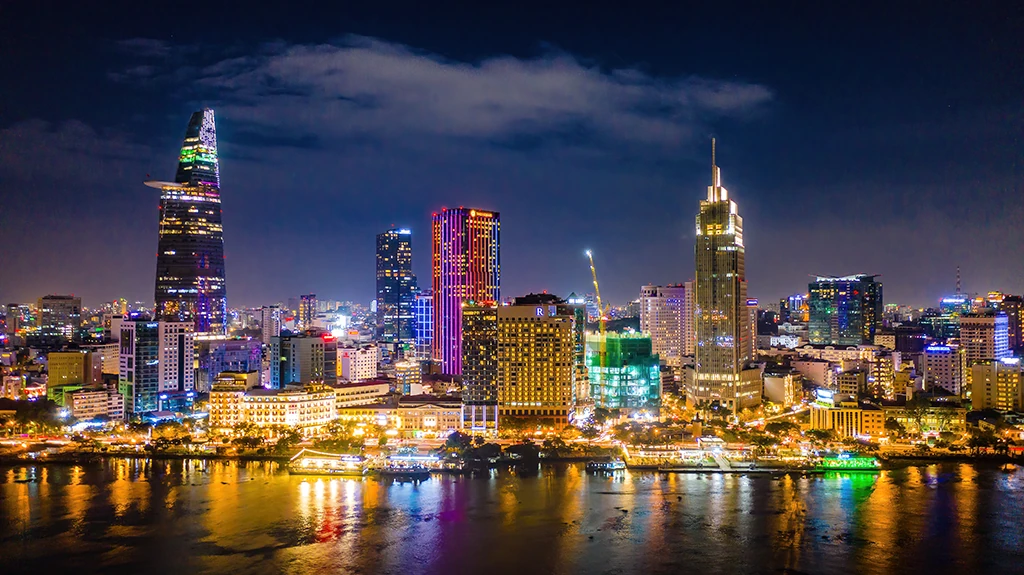
Because Tan Son Nhat International Airport lies directly inside the urban core of Ho Chi Minh City, central District 1, Thu Thiem, and the Saigon Riverfront are strictly designated as red zones requiring special advance clearance. Authorities have detained and fined multiple foreign visitors attempting sunset skyline shots near Landmark 81 and Thu Thiem Bridge without Ministry of Defence permits.
In Da Nang—where commercial runways sit minutes from My Khe Beach and Han River bridges—military air defense teams and municipal police have cracked down hard after dozens of flights were disrupted by illegal drones. Foreign tourists have been arrested on the spot for flying near airport approach paths and coastal defense zones. Meanwhile, flying at the iconic Golden Bridge (Ba Na Hills) requires two separate permits: an official flight permit from the Ministry of National Defence and written site permission from property owner Sun Group.

Local police and military units in Hanoi have repeatedly intercepted both foreign tourists and local creators launching drones around Hoan Kiem Lake, West Lake, and the Ba Dinh political district. Because central Hanoi sits inside a permanent red zone protecting key state institutions, operators were tracked down within minutes, had their aircraft confiscated, and received administrative fines of 20–30 million VND.
4. Legal Penalties: Confiscation, Joint Tracking & Criminal Prosecution
Under Decree 144/2021/ND-CP, the 2024 Law on People’s Air Defense, and the Vietnamese Penal Code, unauthorized drone operation is treated as an aviation and national security offense—not a minor park infraction.
Escalating Consequences for Severe Violations
- Joint Police & Military Tracking: When an unauthorized signal is detected in a red zone, heritage site, or airport corridor, local Public Security (Police) and Military Air Defense units coordinate immediately to triangulate the controller’s GPS location and intercept the pilot on the ground.
- Heavy Fines & Permanent Confiscation: Flying without a required permit or local coordination carries administrative fines of 20,000,000 to 30,000,000 VND (~$800–$1,200 USD), up to 40,000,000 VND for obstructing aviation corridors, plus mandatory confiscation of the drone and controller.
- Criminal Charges & Imprisonment: Under Article 271 of the Penal Code (Obstructing Air Traffic) and national security provisions, if an unlicensed drone disrupts commercial flights, forces an emergency diversion, injures bystanders, or compromises restricted defense zones, offenders face criminal prosecution, deportation, and prison sentences ranging from 6 months up to 3–10 years depending on the severity of the impact.
5. Airport Customs & Airline Battery Rules
Arrival Customs Inspection
Personal drones are permitted through customs at Hanoi (HAN), Ho Chi Minh City (SGN), and Da Nang (DAD), though scanners regularly flag camera bags. Declare honestly that the unit is for personal travel photography and pack it neatly inside your primary camera backpack rather than oversized cinema cases.
LiPo Battery Airline Rules
All drone batteries must travel in carry-on luggage only—never in checked bags. Batteries under 100Wh are allowed without prior approval, while 100–160Wh batteries require airline declaration. Store each battery in a LiPo-safe pouch or tape over the terminals.