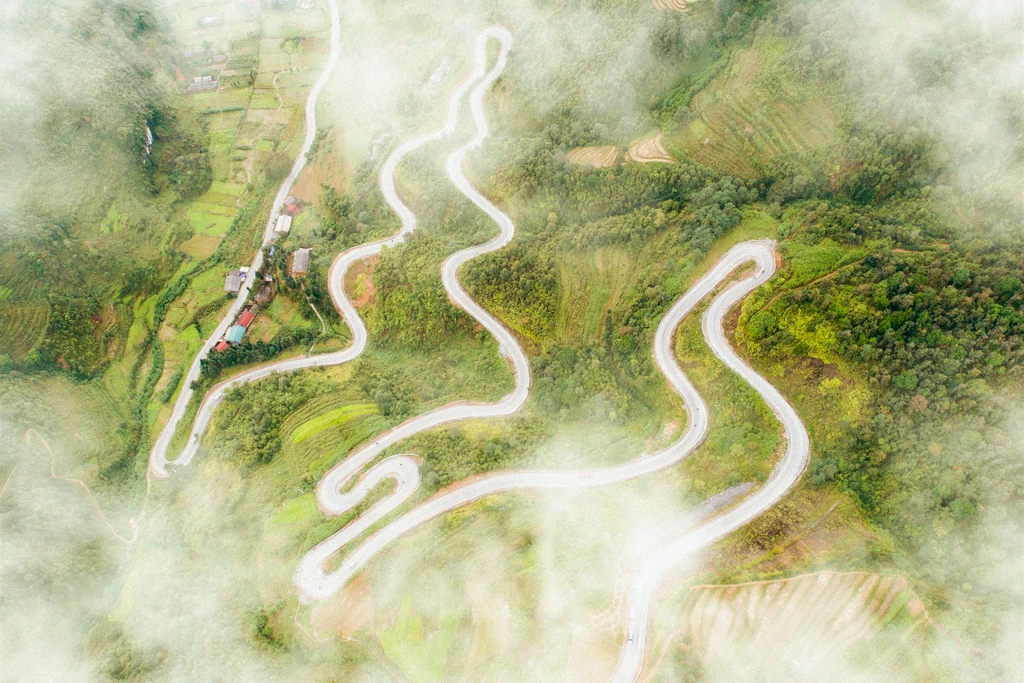
In the conventional visual vocabulary of travel, "good weather" is almost always synonymous with cerulean skies and the reliable warmth of the golden hour. We are taught to wait for the sun, to pack away our cameras when the clouds bruise over, and to seek shelter at the first sign of a drizzle. However, for the serious photographer, these pristine conditions can often be the most predictable—and, ironically, the most limiting.
In Vietnam, a country defined by its dramatic verticality and its 2,000-mile intimacy with the East Sea, the most evocative stories aren't told in the midday sun. They are whispered when the atmosphere turns thick, when the mountains of the North disappear into a white void, and when the ancient streets of Central Vietnam become shimmering mirrors of light and rain.
Rain, fog, and the sweeping power of the monsoon are not obstacles to be avoided; they are powerful aesthetic tools. They simplify cluttered backgrounds, enhance color saturation to a jewel-like intensity, and introduce a cinematic mood that "perfect" light simply cannot replicate. To photograph Vietnam in its "bad" weather is to witness its resilience and its rawest beauty. This is a field-tested strategy for turning meteorological challenges into the most compelling pieces of your portfolio.
1. Decoding the Regional Pulse: The Photographer’s Weather Map
Vietnam’s weather is not a singular event; it is a complex, regional conversation between the Himalayas, the South China Sea, and the tropical equator. An American photographer arriving in January might find a bone-chilling mist in Sapa, a persistent drizzle in Hue, and a sweltering sun in Ho Chi Minh City. Understanding these distinct zones is the first step in mastering the "atmospheric" shot.
The Northern Highlands: The Realm of the White Void (December – March)
In the high-altitude regions of Sapa, Y Tý, and Hà Giang, winter brings the mùa sương mù—the foggy season. This isn't the light, poetic haze you might find in the Great Smoky Mountains; it is a dense, shifting blanket of moisture that can obscure entire limestone massifs for days.
For the photographer, this is a lesson in minimalism. The fog acts as a natural "eraser," removing power lines, distant construction, and messy horizons. What remains are the essential shapes: the silhouette of a Hmong woman walking along a terrace ridge, or the gnarled branches of an ancient peach tree.
- Pro Tip: Look for "islands" in the fog. Position yourself on a high pass (like O Quy Ho) and wait for the wind to tear a temporary hole in the clouds, revealing a flash of emerald rice terrace before closing again.
Central Vietnam: The Cinematic Melancholy (September – January)
The central coast, particularly Huế and Hội An, experiences a late-year monsoon that defines the region’s character. In Huế, the former imperial capital, the rain is often a persistent, poetic drizzle known locally as mưa dầm. It matches the city's weathered pagodas and moss-covered citadels perfectly.
In Hội An, the "Ancient Town" takes on a different life. The mustard-yellow walls—so iconic of the city—glow with a deep, saturated ochre when wet. When the Thu Bon River rises and the streets flood, the town becomes a literal mirror, offering reflections of silk lanterns that you simply won't see during the dry season.
The South and Mekong: The Rhythmic Tropical Pulse (May – October)
In Ho Chi Minh City and the Mekong Delta, the monsoon is rhythmic and violent. Unlike the grey, overcast days of the North, the South often enjoys bright mornings followed by spectacular afternoon downpours. These aren't just rains; they are events. The sky turns a bruised purple-black, the wind whips through the palms, and then the sky opens.
The photography here is about energy. It’s about the frantic movement of motorbikes donning colorful plastic ponchos—a sea of moving colors—and the high-octane chaos of a city that refuses to stop for a flood.
2. Technical Mastery: Exposure and Focus in the Elements
Photographing in adverse weather requires a departure from standard exposure theory. Your camera’s "brain"—the internal light meter—is designed for average conditions. When faced with a world of white fog or dark, rain-slicked asphalt, it will inevitably make mistakes.
Mastering the Fog: The High-Key Strategy
Fog acts as a giant natural softbox, scattering light in every direction. This creates beautiful, soft shadows, but it also fools your camera into thinking the scene is much brighter than it actually is. Left to its own devices, your camera will underexpose the shot, resulting in "muddy" grey fog instead of a clean, ethereal white.
- Exposure Compensation: You must manually intervene. Dial in +0.7 to +1.3 EV. This "pushes" the histogram to the right, ensuring your whites stay white while maintaining detail in the shadows.
- The Contrast Struggle: Fog reduces contrast, which makes modern autofocus systems "hunt" because they can't find a hard edge to lock onto.
- The Fix: Switch to Manual Focus using your camera's focus peaking, or find a high-contrast anchor point (like a dark tree trunk or a person’s silhouette) at the same focal plane to lock your focus before recomposing.
Shutter Speed: Freezing vs. Blurring the Rain
How do you want the rain to "feel"? This is a creative decision dictated by your shutter speed.
- To Freeze the Action (1/500s or faster): If you want to capture individual raindrops suspended in the air like diamonds, you need speed. This technique is most effective when the rain is backlit (see Section 4). The fast shutter speed catches the light refracting through each droplet.
- To Capture the Motion (1/30s to 1/125s): This creates the classic "streaking" effect. It gives the viewer a sense of the volume and direction of the downpour. However, you’ll need a steady hand or a tripod to ensure the static parts of your image (like buildings or trees) remain sharp while the water blurs.
Aperture and Depth of Field
It is tempting to shoot "wide open" (at f/1.8 or f/2.8) in low-light rain, but this can be a mistake. If your depth of field is too shallow, the falling rain will be so out of focus that it simply disappears into a generic blur. Stopping down to f/5.6 or f/8 provides a deep enough plane of focus to ensure that the raindrops across the frame are visible and textured.
3. Gear Care: Protecting Your Investment in the Tropics
Vietnam’s humidity is a silent killer for electronics. In the North, the moisture is constant; in the South, the heat creates a "steamer" effect after a rain. If you aren't careful, you’ll return home with a fine layer of fungus growing inside your expensive glass.
The Anti-Condensation Protocol
The most dangerous moment for your gear is moving from a cold, air-conditioned hotel room (or tour bus) into the hot, humid Vietnamese air. Your lens will instantly fog—not just on the outside, but potentially on the internal elements.
- The Ziploc Trick: This is the most important tip for any photographer in Southeast Asia. Before leaving your air-conditioned room, seal your camera and lenses in large, airtight plastic bags. Let the gear sit in the bag outside for 20 minutes to reach ambient temperature. The condensation will form on the outside of the bag, not on your sensor or glass.
- The Silica Strategy: Never store your gear in a padded camera bag overnight. Padded bags trap moisture. Instead, use an airtight "dry box" or a simple Tupperware container filled with rechargeable silica gel packets. These packets will pull the moisture out of your gear while you sleep.
In-Field Protection: Beyond the Rain Cover
You don't need an expensive custom-fitted rain housing to get great shots.
- The Deep Lens Hood: A lens hood isn't just for sun flare; it's a "roof" for your front element. A deep hood will keep a surprising amount of drizzle off your glass, allowing you to shoot without constantly wiping the lens.
- Microfiber Rotation: Once a microfiber cloth gets damp, it stops cleaning and starts smearing. Carry at least five cloths, each in its own small Ziploc bag. Use one until it's "spent," then move to a fresh, dry one.
- The Hotel Shower Cap: In a pinch, the free shower cap in your hotel room is the perfect emergency cover for a mirrorless camera. It’s thin enough to let you feel the buttons but waterproof enough to handle a sudden deluge.
4. Creative Composition: The Aesthetics of the Grey
When the "epic" sunset fails to materialize, you must change your compositional strategy. The lack of harsh light allows you to focus on form, texture, and the "Mirror World."
The Power of Backlighting (The "Glow" Factor)
Water is transparent. If you photograph rain with the sun (or a street lamp) behind you, the light passes through the droplets and they effectively disappear. To make rain visible, you must backlight it.
Position yourself so a light source—a shop window in the Old Quarter, a motorbike headlight, or a break in the clouds—is behind your subject. The light will catch the edges of the raindrops, making them glow against the darker background. This creates that iconic "cinematic" look found in noir films.
The Mirror World: Puddles as Portals
Rain turns the textured streets of Hanoi or Hội An into a giant, fragmented mirror. Most travelers walk around puddles; photographers should get inside them.
- Get Low: Literally put your camera an inch above the water’s surface. This creates a perfectly symmetrical "double world" effect.
- The CPL Hack: Use a Circular Polarizer. While we usually use these to blue-up skies, in the rain, they are used to control reflections. You can rotate the filter to either maximize the reflection (the "Mirror" look) or cut through it to reveal the colorful tiles or cobblestones beneath the water.
Subject Isolation and Negative Space
Fog is the ultimate "distraction remover." In a busy country like Vietnam, it can be hard to find a clean background. Fog solves this by physically wiping out power lines, distant buildings, and cluttered horizons.
Use this to create "graphic" compositions. A single boatman on the Perfume River in Hue, surrounded by a white void, becomes a study in shape and form. It feels lonely, poetic, and timeless—qualities that are hard to capture on a bright, busy day.
5. Mindset: The "Storm Chaser" Philosophy
The greatest difference between a professional and an amateur is their reaction to a dark sky. When the clouds roll in over the Mekong Delta, the amateur goes for coffee; the professional puts their rain jacket on.
Embracing "Flat" Light for Portraits
American photographers are often obsessed with "golden hour," but harsh sunlight is actually the enemy of great portraiture. It creates "raccoon eyes" (dark shadows in the eye sockets) and blown-out highlights on skin.
An overcast, rainy day provides the most flattering light possible. It is soft, directional-less, and gentle. This is the perfect time to visit a local market. The subtle skin tones of a street vendor, the vibrant greens of the herbs, and the rich textures of the woven baskets will all be captured with a fidelity that "good" weather would ruin.
The Narrative of Resilience
Rain is a fundamental part of the Vietnamese identity. The country was built on wet-rice cultivation; water is seen as a source of life and wealth.
A photo of a motorbike rider balanced precariously with three children under a single tarp, or a vendor continuing to fry bánh xèo under a tattered umbrella, tells a story of "daily life" that a sunny day simply cannot. These images have a pulse; they feel lived-in, authentic, and uniquely Vietnamese. You aren't just taking a picture of the weather; you are capturing the atmospheric soul of a nation that has learned to thrive in the rain for millennia.
6. Post-Processing: Bringing the Mood to Life
When you shoot in "bad" weather, your RAW files will often look flat and uninspiring straight out of the camera. This is normal. The magic happens in the edit.
- Dehaze with Caution: In Adobe Lightroom, the "Dehaze" slider is your best friend for fog shots. Moving it to the right will bring back details in the mist. However, don't overdo it—part of the beauty of fog is its softness.
- White Balance: Rainy shots often come out very blue (cool). Try warming up the white balance slightly to bring back the "glow" of street lights, or lean into the blues for a more "moody/melancholy" aesthetic.
- Contrast and Clarity: Increase your "Whites" and "Blacks" to add "pop" to a flat grey image. This creates a dynamic range that the flat light originally hid.
7. Decision-Making Framework: Your Weather Strategy Table
| Condition | Best Subject | Exposure Strategy | Essential Gear |
| Heavy Monsoon | Urban Motion / Puddles | 1/250s (To stop motion) | Rain Sleeve / Umbrella |
| Dense Fog | Mountain Minimalist | +1.0 EV (To keep whites bright) | Manual Focus / Tripod |
| High Humidity | Detailed Portraits | Meter for Mid-tones | Silica Gel / Microfiber |
| Post-Rain | Reflections / Macro | Bracket (HDR) for dynamic range | Circular Polarizer |
8. Conclusion: The Rain is Your Friend
Vietnam is a country of water. It is in the rice paddies that terrace the mountains, the 2,000 rivers that vein the landscape, and the humid breath of the cities. To fear the weather is to miss the very essence of the place.
The next time you see a storm front moving across the horizon in Da Nang or the fog thickening in the valleys of Hà Giang, do not pack your bags. Adjust your settings, protect your glass, and step out into the elements. The light may be "bad," but the photos will be better than anything you could have captured under a clear blue sky.
You are no longer just a tourist with a camera; you are a storyteller, capturing the atmospheric soul of Vietnam.