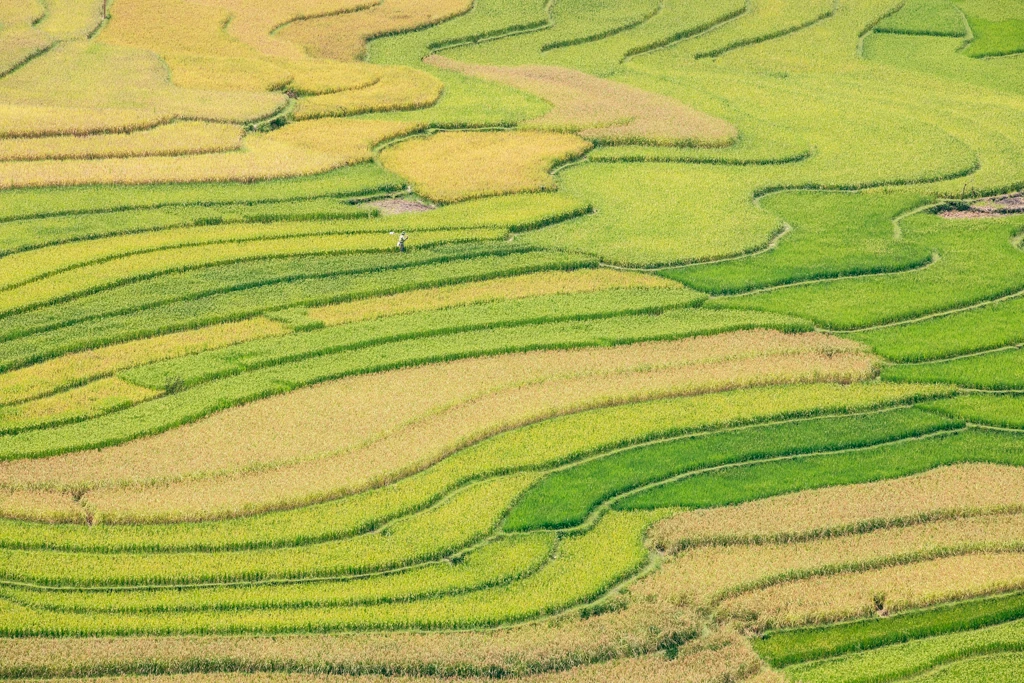
Rice terraces in northern Vietnam are not just landscapes. They are engineered sculptures shaped by generations of Hmong, Dao and Thai communities over centuries. To photograph them well requires more than arriving at golden hour.
You must understand:
- Seasonal cycles
- Light direction across mountain faces
- Atmospheric layering
- Local farming rhythms
- Road access and elevation changes
This guide breaks down both Sapa and Mu Cang Chai from a professional landscape photographer’s perspective.
Understanding the Difference Between Sapa and Mu Cang Chai
Many photographers treat them as interchangeable. They are not.
Sapa
- Higher elevation
- More dramatic mountain backdrops (Fansipan range)
- Heavier tourism infrastructure
- More accessible viewpoints
- Frequent fog and cloud inversions
Visual character: layered, misty, dramatic.
Mu Cang Chai
- More remote
- Cleaner terrace geometry
- Less urban interference
- Wider open valley perspectives
- Stronger sculptural curves
Visual character: graphic, rhythmic, expansive.
For a complete portfolio, you need both.
Seasonal Strategy – The Most Important Decision
Rice terraces change dramatically through the year. Timing determines everything.
Water Season (Late May – Mid June)
Farmers flood terraces before transplanting.
Visual advantage:
- Mirror reflections
- Graphic lines
- Sky color reflecting in water
Best for:
- Drone photography
- Minimalist compositions
- Symmetry and abstract patterns
Challenges:
- Muddy roads
- Unpredictable storms
- Limited green tones
This is the most underrated season.
Green Season (Late June – August)
Terraces become bright green.
Best for:
- Soft rolling texture
- Layering in mist
- Human activity scenes
Downside:
- Harsh summer sun
- Flat midday contrast
Shoot early morning or after rain.
Golden Harvest (Late September – Early October)
Peak tourism season.
Terraces turn golden yellow.
Best for:
- Classic postcard shots
- Dramatic ridge silhouettes
- Human harvesting scenes
Challenges:
- Crowds
- Fast harvest (window only ~2 weeks)
- Dust haze in dry weather
Professional tip:
Arrive slightly before peak — when terraces are half green, half yellow. More texture and tonal variation.
Getting There – Logistics & Access
From Hanoi to Sapa
Option 1:
Overnight sleeper train to Lao Cai + 1 hour car to Sapa.
Option 2:
5–6 hour expressway by private car or limousine van.
Road condition: Good.
From Sapa to Mu Cang Chai
Drive via O Quy Ho Pass → Than Uyen → Mu Cang Chai.
Time: 5–6 hours.
Alternative:
Direct from Hanoi to Mu Cang Chai via Nghia Lo (~7–8 hours).
Roads are winding mountain passes. Not ideal for inexperienced self-driving.
Best strategy:
Hire experienced local driver for flexibility.
Sapa – Technical Field Breakdown
Key Locations
Muong Hoa Valley
Most accessible terrace system.
Best time:
- Sunrise for mist
- After light rain
Lens:
- 24-70mm for mid-range compression
- 70-200mm for isolating curves
Use elevation shifts to create layered stacking.
O Quy Ho Pass
High elevation dramatic views.
Best for:
- Sunset silhouettes
- Cloud inversions
- Telephoto compression of mountain layers
Weather changes rapidly. Monitor cloud movement.
Y Ty (nearby extension)
Less visited.
Strong mist potential.
Requires 4WD in wet season.
Mu Cang Chai – The Graphic Masterpiece
The most famous terraces:
- La Pan Tan
- Che Cu Nha
- De Xu Phinh
Each offers different geometry.
La Pan Tan
Iconic spiral terraces.
Best:
- Sunrise
- Drone vertical top-down shot
Ground level:
Use 70-200mm to compress spirals into abstract shapes.
Che Cu Nha
More remote, fewer tourists.
Best:
- Side light late afternoon
- Human activity during harvest
Look for:
Farmers walking along terrace edges.
Drone Strategy
Rice terraces are ideal for aerial perspective.
Best season:
Water season.
Height:
30–60 meters for graphic compression.
Avoid:
Too high altitude (loses pattern detail).
Light:
Overcast days ideal for drone.
Harsh sun creates blown highlights in water reflections.
Sunrise vs Sunset Strategy
Sunrise
Pros:
- Mist
- Calm wind
- Soft gradients
Cons:
- Requires early departure (4:30–5:00 AM)
- Cloud coverage unpredictable
Sunset
Pros:
- Side light enhances terrace curves
- Warm tones
Cons:
- Haze buildup in afternoon
Best approach:
Shoot both when possible.
Weather Tactics
Mountain weather changes hourly.
Fog strategy:
Shoot into light for glow.
Use backlit mist.
Rain strategy:
Wait after rain stops.
Cloud layers separate beautifully.
Never cancel shoot due to fog — fog is opportunity.
Composition Framework
Rice terraces are repeating lines.
Three main approaches:
Leading Curves
Use terraces as natural S-curves.
Layer Compression
Telephoto stacking of distant ridges.
Human Scale
Insert farmer for size reference.
Without human element, terraces can feel abstract and repetitive.
Lens Strategy
Essential kit:
- 16-35mm for wide valley shots
- 24-70mm for flexibility
- 70-200mm for compression
- Drone
Prime lenses optional.
Avoid ultra-wide distortion unless intentional.
Exposure Strategy
Highlights in water season easily clip.
Shoot:
- Slightly underexposed (-0.3 to -0.7 EV)
- Recover shadows later
Golden season:
Expose for highlights in rice.
Protect yellow tones from over-saturation.
Cultural Sensitivity
These are working farms.
Do not:
- Walk inside planted terraces
- Block harvesting
- Stage labor scenes
Ask before close portraits.
Support local homestays.
Accommodation Strategy
Sapa
Many hotel options.
Stay outside town center for quiet.
Mu Cang Chai
Homestays in La Pan Tan or town center.
For serious photography:
Stay near terrace clusters to reduce driving at 4 AM.
How Many Days Do You Need?
Minimum:
- 3 days Sapa
- 2 days Mu Cang Chai
Ideal:
6–7 days total
This allows weather flexibility.
Common Mistakes
- Shooting only famous viewpoints
- Ignoring mid-day scouting
- Relying too heavily on drone
- Over-saturating green tones
- Not accounting for harvest timing
Editing Strategy
Water season:
Enhance contrast subtly.
Avoid over-polarization.
Green season:
Reduce green saturation slightly.
Increase clarity on ridge edges.
Golden season:
Warm tones gently.
Avoid turning rice orange.
Building a Portfolio Narrative
Sequence matters.
Start with:
- Wide establishing landscape
Move to:
- Mid-range curves
End with:
- Human connection
Tell the story of land + labor.
Final Thought
Rice terraces are slow photography.
They require:
- Patience
- Weather tolerance
- Physical stamina
- Respect for farmers
If you rush them, you capture scenery.
If you study them, you capture design.
Sapa gives you drama.
Mu Cang Chai gives you rhythm.
Together, they give you mastery.