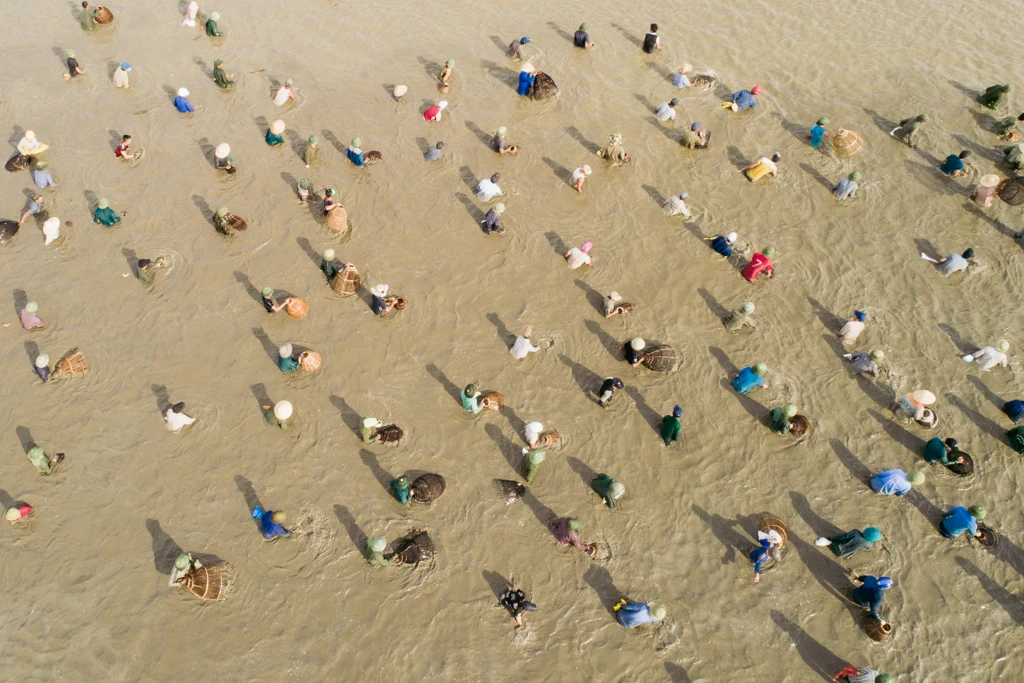
Life by the Water: Vietnam’s Fishing Communities and a Changing Coastline
For over three thousand kilometers, the S-shaped curve of Vietnam is defined by its relationship with the East Sea and the complex vascular system of the Mekong Delta. To look at a map of Vietnam is to see a nation that is more water than land—a country where the rhythm of the tides has, for centuries, dictated the rhythm of the soul.
However, as we move through 2026, the traditional image of the lone fisherman in a wooden sampan is increasingly a relic of the past. The coastline is in a state of profound flux. Economic imperatives, the relentless march of climate change, and a generational exodus from the sea are reshaping the communities that have long served as the backbone of Vietnam’s maritime identity. To document these communities today requires more than a lens for the "picturesque"; it requires a journalistic commitment to recording a landscape under pressure.
The Two Faces of the Water: Central Coast vs. Mekong Delta
To understand Vietnamese fishing culture, one must distinguish between the "Front Line" of the Central Coast and the "Labyrinth" of the Mekong Delta. Their methods, vessels, and philosophies are products of their specific geographies.
Central Vietnam: The Confrontation with the Deep
In provinces like Thừa Thiên Huế, Quảng Nam, and Bình Định, fishing is an act of endurance. The coast here is exposed to the full force of the East Sea. The lagoons—most notably Phá Tam Giang, the largest lagoon system in Southeast Asia—act as a buffer zone.
In the lagoons, the water is brackish and relatively still, supporting a culture of "sedentary" fishing: stilt houses, fixed nets (rớ giàn), and traps. However, just beyond the barrier islands, the "deep sea" fishermen face a much harsher reality. These are the communities of the steel-hulled trawlers, often spending weeks at sea near the Paracel or Spratly Islands. Their identity is one of sovereignty as much as it is of commerce; they are the "living milestones" of Vietnam’s maritime borders.
The Mekong Delta: Life in the Vascular System
In the South, the relationship with water is riverine and intimate. In An Giang and Cần Thơ, the "fishing village" is often a floating entity. Houses are built on pontoons with fish cages suspended beneath the living room floor.
Here, the water is not an adversary to be conquered, but a medium for life. The fishing is dictated by the "flooding season" (mùa nước nổi), which brings a bounty of linh fish and river shrimp. However, this ecosystem is the most fragile in the country. The upstream damming of the Mekong and the increasing salinity of the water are forcing a radical shift from wild fishing to intensive aquaculture, changing the visual and social fabric of the Delta.
The Daily Rhythm: A Choreography of Labor
The life of a fisherman is a 24-hour cycle that remains largely invisible to the urban dweller. It is a choreography of high-intensity labor punctuated by long periods of expectant waiting.
Pre-Dawn: The Silent Departure
The workday begins when the rest of the country is in its deepest sleep. Between 2:00 AM and 4:00 AM, the shorelines of Central Vietnam come alive with the low thrum of diesel engines. This is the "silent departure." In the darkness, the fishermen rely on instinct and GPS to reach their grounds before the first light hits. For the photographer, this is the most atmospheric time—a world of silhouettes, headlamps, and the smell of brine and exhaust.
Midday: The Market Nexus
As the sun climbs, the focus shifts back to the shore. The "return" is a frantic window of economic exchange. This is where the gender roles of the fishing community are most clearly defined. While the men master the water, the women master the market. As the boats land, wives and middlewomen (thương lái) descend upon the catch. The air is thick with the sound of negotiation and the wet slap of fish onto plastic crates. This is not a place for "slow" photography; it is a high-speed environment where the labor is visceral and the stakes are high.
Sunset: The Repair of the Tools
By late afternoon, the focus turns to maintenance. Fishing is a war of attrition against salt and sun. The "quiet hours" before dusk are spent mending nets (đan lưới), caulking hulls with resin, and preparing bait. This is a meditative phase of the cycle, offering a glimpse into the craftsmanship that supports the industry.
A Changing Tide: The Socio-Economic Shift
The most critical story of 2026 is not what remains, but what is disappearing. The fishing villages of Vietnam are currently navigating three major "tsunamis" of change.
1. The Generational Exodus
The most significant threat to traditional fishing is not a lack of fish, but a lack of fishermen. The youth of the coastal provinces are moving to the industrial zones of Da Nang, Bình Dương, and Saigon. Fishing is seen as "vất vả" (arduous) and "bấp bênh" (precarious). In many villages, the average age of a boat captain is now over 50. We are witnessing the "atrophy" of maritime knowledge—the loss of the ability to read the winds or the subtle changes in water color.
2. Modernization and Steel
The "Wooden Boat Era" is ending. Government subsidies have encouraged a transition to steel-hulled vessels, which are safer and more efficient for deep-sea excursions. While this is a positive for safety and economics, it has altered the aesthetics of the coastline. The traditional "coracle" (thuyền thúng)—the iconic round bamboo basket boat of Central Vietnam—is increasingly being replaced by plastic and composite versions, or relegated to the tourism sector.
3. The Climate Front Line
Vietnam’s coastline is one of the most vulnerable in the world to climate change.
- Salinity Intrusion: In the Mekong, the rising sea levels are pushing saltwater further inland, destroying the freshwater fish stocks that communities have relied on for generations.
- Storm Intensity: Typhoons are becoming more frequent and unpredictable, shortening the "fishing window" and increasing the financial risk of every voyage.
- Coastal Erosion: Entire villages in Cà Mau and Hội An are literally slipping into the sea, forcing "climate migrations" that break the historical link between a family and its ancestral shoreline.
Field Guide: Technical Photography on the Water
Documenting this environment requires a specialized technical approach. The coast is a place of extreme light, corrosive salt air, and constant motion.
1. Silhouettes and Exposure Management
The "golden hour" on the water creates high-contrast scenarios. To capture the iconic silhouette of a fisherman casting a net:
- Meter for the Highlights: Use spot metering on the brightest part of the sky. This ensures the highlights aren't "blown out" and renders the fisherman as a clean, black silhouette.
- Shutter Speed: Use a minimum of 1/1000s to freeze the droplets of water as the net is cast.
2. Long Exposure: Texturing the Water
In the lagoons of Central Vietnam, the fixed nets and stilt houses offer perfect subjects for long-exposure photography.
- Gear: Use a 6-stop or 10-stop ND filter to blur the movement of the water into a misty, ethereal texture. This emphasizes the stillness and "permanence" of the structures against the fluid sea.
- Stability: When shooting on sand, your tripod will "sink." Use "snow shoes" for your tripod or push the legs deep into the wet sand until they hit a stable layer.
3. Boat-to-Boat Shooting
Capturing the action from another vessel is the most challenging scenario.
- The Vibration Factor: Diesel engines create a high-frequency vibration. Never lean your elbows or camera against the boat’s railing. Your body must act as a shock absorber.
- Lens Selection: A 70-200mm f/2.8 is the essential tool. It allows you to keep a safe distance from the fishing boat while providing the "compression" needed to make the subject pop against the horizon.
- AF Mode: Use Continuous AF (AF-C) with tracking. The distance between the two boats is constantly changing,and a static focus will result in soft images.
4. Telephoto Compression
The "layering" of the Vietnamese coast is spectacular. Use a long focal length (200mm+) to compress the visual distance between the foreground boats, the midground nets, and the background mountains. This creates a "painterly" effect that emphasizes the scale of the environment.
Ethics and Safety: Beyond the Postcard
Documenting labor-intensive industries requires a high level of situational awareness and ethical restraint.
Safety First
The sea is a dangerous workplace.
- Life Jackets: Always wear a PFD (Personal Flotation Device), even if the locals aren't. A camera bag makes you top-heavy and difficult to swim with.
- Salt Protection: The salt spray will destroy your gear in hours. Use "rain covers" even on sunny days, and wipe down your lenses with fresh water and microfiber cloths immediately after the shoot.
Ethical Considerations: Documenting Labor
- Avoid the "Happy Poor" Cliché: There is a tendency in travel photography to depict fishermen as "simple but happy." This ignores the reality of debt, physical pain, and environmental anxiety. Look for images that show the competence and professionalism of the work.
- The "Intrusion" Factor: During the morning market, people are moving fast with heavy loads. Do not block their paths for a "better angle." You are an observer, not a participant in their economic cycle.
- The Tourism Trap: In places like Hội An, "traditional fishing" is often staged for tourists. As a documentary photographer, learn to distinguish between the performance (clean nets, colorful clothes) and the practice (mended gear, weathered faces, genuine labor).
Conclusion: Recording a Transition
The fishing communities of Vietnam are not dying, but they are evolving at a speed that is difficult to process. The "Life by the Water" in 2026 is a hybrid reality—a mix of ancient tidal intuition and modern satellite navigation, of traditional wooden hulls and the encroaching concrete of coastal resorts.
As photographers and writers, our duty is to capture this "middle ground." We must document the calloused hands that still mend the nets, even as the eyes of the next generation are turned toward the city lights. By moving past the sentimental clichés of the "scenic coast," we can provide a true record of a people who, despite the changing tides, remain inextricably linked to the pulse of the sea.