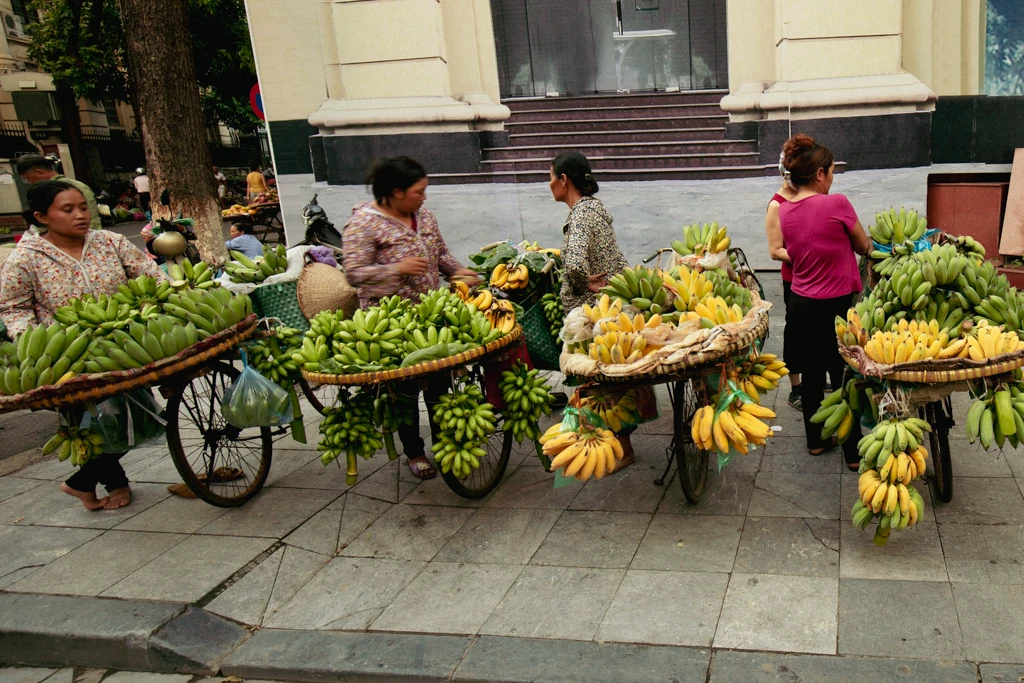
As dawn breaks over Hanoi’s Old Quarter, the city does not wake up to the sound of engines, but to the rhythmic click-clack of bamboo on pavement. Long before the first tourist arrives for a salt coffee, and before the white-collar workers descend upon the gleaming glass towers of District 1 in Ho Chi Minh City, the "invisible workforce" has already been active for hours.
Street vendors—carrying the weight of the provinces on their shoulders or the back of a weathered Honda Cub—are more than just a picturesque "feature" of the Vietnamese cityscape. They are the scaffolding of the urban economy. To the casual observer, they are a fleeting blur of conical hats and colorful fruit; to the city, they are a vital logistics network, a social safety net, and the primary weavers of Vietnam’s unique social fabric.
Yet, as we enter 2026, this workforce faces a crossroads. Between the aggressive modernization campaigns of the 2024 Capital Law and the relentless rise of the platform economy, the traditional street vendor is becoming a ghost in the machine. For the documentary photographer and the cultural analyst, documenting this transition is not just about capturing a "vanishing world"—it is about understanding the very nature of labor, space, and survival in a rapidly evolving Vietnam.
The Dual Realities: Hanoi’s Alleys vs. Saigon’s Arteries
While the term "street vendor" is used nationally, the character of this labor varies significantly between the two major hubs. To photograph and understand them, one must recognize these distinct regional identities.
Hanoi: The Poetry of the Pavement
In Hanoi, street commerce is defined by the ngõ (alleyway). These narrow, damp arteries are the natural habitat of the roving vendor (người bán hàng rong). Because the architecture of the Old Quarter resists large-scale retail, the vendor serves as a mobile grocery store.
The Hanoian vendor is often a migrant woman from neighboring provinces like Nam Định or Thái Bình. Her tool is the đòn gánh (the shoulder pole). This simple piece of bamboo is a marvel of physics, distributing the weight of two heavy baskets while providing a rhythmic gait that prevents muscle strain. In Hanoi, the vendor is a seasonal clock; in February,she carries peaches and kumquats; by May, it is the fragrance of lotus flowers.
Ho Chi Minh City: The Motorized Marketplace
Contrast this with Ho Chi Minh City (Saigon), where the pace is dictated by the motorbike. Here, the "invisible workforce" is more mobile and technologically integrated. Street food is not just carried; it is engineered onto the backs of motorbikes. Portable coffee stations, mobile bánh mì stands, and even entire clothing displays are mounted on wheels to navigate the city's vast, sweltering grid.
Saigon’s vendors are the masters of the "drive-thru" culture. A commuter can buy a hot meal and a cold drink without ever putting their kickstand down. This is the ultimate efficiency of the informal sector—a high-speed exchange that keeps the city’s heart beating.
The Battle for the Sidewalk: Governance and Modernity
In the last two years, the tension between "order" and "vibrancy" has reached a fever pitch. The implementation of the 2024 Capital Law in Hanoi has signaled a new era of urban management.
The Cleanup Campaigns
Beginning in late 2025 and continuing through Q1 2026, authorities have ramped up campaigns to "restore urban order." The goal is a "modern, civilized city" with clear sidewalks and orderly traffic. For the vendor, this means a constant game of cat-and-mouse with the Công An (police) and urban order officials.
This conflict creates a psychological weight that is often invisible in a photo. The vendor is constantly scanning the horizon, ready to hoist their pole or start their engine at the first sign of a green uniform. This precarity is the defining emotion of their 2026 reality.
The Paradox of Public Space
Urban planners often view street vendors as a "hindrance" to flow. However, sociologists argue that vendors actually create public space. By occupying a corner, they transform a sterile sidewalk into a community hub. They are the "eyes on the street," providing informal security and social interaction for the elderly and the lonely. When a city removes its vendors, it often removes its soul, replacing a living market with a concrete corridor.
Generational Shifts: From Bamboo Poles to TikTok Shops
The most profound change in the vendor workforce is not legislative, but generational. The children of the women carrying shoulder poles are rarely following in their footsteps. Instead, the "invisible workforce" is migrating to the digital street.
The Rise of the Platform Economy
In 2026, the line between a street vendor and a digital merchant is blurring. Many younger vendors have bypassed the physical sidewalk entirely, using TikTok Shop or GrabFood as their storefront.
- The Hybrid Vendor: You will now see traditional vendors with QR codes pinned to their baskets. The transaction is no longer just cash; it’s an e-wallet transfer.
- Social Commerce: The "shoppertainment" model is thriving. A vendor may spend their morning selling fruit on the street and their evening livestreaming their "handmade" processing techniques to a national audience.
This shift has created a "restructuring" of the informal economy. While it offers more comfort, it also introduces new pressures: algorithm dependency, platform fees, and the loss of the face-to-face social bonds that defined the old hàng rong culture.
The Ethics of the Lens: Documenting Labor without "Poverty Porn"
For photographers, the street vendor is an irresistible subject. However, there is a fine line between documentary storytelling and cultural exploitation.
Avoiding the "Romanticized Struggle"
A common mistake is to photograph the vendor as a "timeless" or "poetic" figure, ignoring the grueling physical toll and the economic necessity that drives their work. To avoid romanticizing poverty, the photographer must seek to capture agency rather than just pathos.
- The Gaze: Avoid only shooting from high angles (which can feel patronizing) or extreme low angles (which can feel overly heroic). Shoot at eye level to establish a peer-to-peer connection.
- Context over Costume: Don’t just focus on the conical hat. Capture the ledger where they track their debts, the smartphone they use to call their children in the province, or the worn-out soles of their shoes. These are the markers of reality.
Informed Consent in a Public Space
While public photography is legal, the ethical burden remains. A vendor is working; every minute they spend posing for you is a minute they aren't earning.
- The Transaction: If you take a portrait, buy their product. It is the simplest and most respectful way to acknowledge the value of their time.
- Sharing the Work: Whenever possible, show them the photo. In a world of digital disposability, a physical print or even a shared digital file can be a meaningful gesture of reciprocity.
Photography Masterclass: Techniques for the Urban Documentary
Documenting the "invisible workforce" requires a blend of technical precision and social intuition. The following breakdown provides a strategy for capturing the nuance of Vietnamese street life.
1. The Strategic Approach: Fisherman vs. Hunter
- The Fisherman: Find a visually compelling background—perhaps a weathered yellow wall in Hanoi or a neon-lit intersection in HCMC. Wait for the subject to enter the frame. This allows you to control the composition and lighting perfectly.
- The Hunter: Move with the flow. Follow a vendor as they navigate a crowded market. This approach yields more dynamic, "in-the-moment" shots but requires faster reflexes and a smaller camera footprint.
2. Layering for Depth
Vietnamese streets are chaotic. Rather than fighting the chaos, use it as a compositional tool.
- Foreground: A blurred motorbike wheel or a stack of bánh mì.
- Middle Ground: The vendor engaged in a transaction.
- Background: The city’s architecture or the "sea" of other commuters. This layering creates a sense of "immersion," making the viewer feel like they are standing in the heat and noise of the street.
3. Mastering the Light
- The Tropical Harshness: From 10:00 AM to 3:00 PM, the sun is brutal. Use this high-contrast light to create graphic, black-and-white images. Look for the "Rembrandt light" created by narrow alleyway openings.
- The Blue Hour & Neon: In HCMC, the period just after sunset is magical. The mix of the deep blue sky and the warm glow of food stalls creates a cinematic atmosphere. Use a wide aperture (f/1.8 or f/2.8) to capture the "bokeh" of city lights.
- The "Hanoi Grey": During the winter months, Hanoi is often shrouded in mist and smog. This acts as a giant softbox. Colors become muted and pastel, which is perfect for capturing the more somber, reflective side of the vendor’s life.
4. Technical Specs
- Focal Length: A 35mm prime is the gold standard. It is wide enough to show the environment but tight enough for an intimate portrait. A 50mm is excellent for isolating the subject from the "visual noise" of the street.
- Shutter Speed: To convey the speed of the city, experiment with "panning" shots. Use a slow shutter speed (1/15s or 1/30s) and track a vendor on a motorbike. This keeps the subject sharp while blurring the background into a streak of color.
Seasonal and Lighting Considerations
The "mood" of the street vendor’s story changes with the calendar.
The Tet Rush (Lunar New Year)
In the weeks leading up to Tet, the streets explode with color. Vendors carry entire peach trees or vast mountains of marigolds. The lighting is often festive, but the pace is frantic. This is the best time for "high-energy" documentary work,focusing on the sheer scale of the informal economy.
The Monsoon Season
Rain transforms the city. The reflection of neon signs on wet asphalt provides a secondary "canvas" for your photos.Documenting vendors under plastic tarps or wearing colorful ponchos highlights their resilience. The "flat" light of a rainy day is excellent for saturated, moody color work.
The Midday Lull
Between 12:00 PM and 2:00 PM, the "invisible workforce" takes a collective breath. You will see vendors napping on their motorbikes or sharing a meal in a doorway. This is the time for quiet, intimate storytelling. It is the moment when the "workforce" becomes human again.
Conclusion: The Soul on the Sidewalk
The street vendors of Vietnam are not merely remnants of a bygone era; they are a resilient, adaptive, and essential part of the modern city. While 2026 brings new challenges—from "clean sidewalk" decrees to the digital encroachment of TikTok—the fundamental human need for the "street connection" remains.
As photographers and observers, our role is to look past the conical hat and the colorful fruit. We must see the migrant mother sending money back to her village; the young entrepreneur balancing a tray of iced coffees on a moving bike; and the elderly woman who has sat on the same corner since the 1970s.
When we photograph the "invisible workforce," we aren't just taking a picture of a person. We are documenting the heartbeat of Vietnam—a heartbeat that persists despite the noise of progress, proving that the soul of the city will always be found on the pavement.
| Element | Technique | Desired Outcome |
| Perspective | Eye-level (Peer-to-peer) | Dignity and agency |
| Timing | Blue Hour (Post-sunset) | Cinematic atmosphere |
| Composition | Layering (Traffic/Environment) | Immersion and "vibe" |
| Ethics | Transaction (Buy the goods) | Reciprocity and respect |
"The street is the only place where the private life of the city becomes public. To document it is to write the history of the present."