Whether you are navigating the labyrinthine alleys of Hanoi’s Old Quarter or trekking through the limestone karsts of Ha Giang, Vietnam presents a unique set of logistical and environmental challenges for photographers. After years of shooting in the humid tropics, the dusty highlands, and the spray of the Mekong Delta, one truth becomes clear: your gear is either an asset or a liability.
This guide outlines a technical, field-tested strategy for building a kit that survives the elements and captures the soul of the S-shaped land.
Minimalist vs. Full Kit: Choosing Your Burden
The "right" amount of gear is a balance between creative capability and physical endurance. Vietnam’s heat (often exceeding 35°C with 90% humidity) makes heavy bags a significant drain on your energy.
The Case for the Minimalist Kit
A minimalist kit—one body and two prime lenses (typically a 35mm and an 85mm)—is the gold standard for street and documentary work in Vietnam. It allows you to move quickly, stay discreet in crowded markets, and reduces the physical fatigue of long shooting days.
- Pros: Faster response time, less conspicuous, easier on the back during mountain treks.
- Cons: Limited reach for distant mountain peaks or candid shots from across a river.
The Full Documentary Kit
For a comprehensive assignment covering everything from the northern rice terraces to the southern delta, a zoom-heavy kit is more practical. This usually includes two bodies (one with a 24-70mm and one with a 70-200mm) to minimize lens changes in dusty or humid environments.
- Pros: Complete focal range, redundancy in case of equipment failure.
- Cons: High weight, requires more intensive weather protection, and draws significant attention in rural villages.
Lens Strategy by Environment
Vietnam is geographically diverse, and each region demands a specific optical approach to maximize storytelling.
Street Photography: The Wide-Angle Context
In cities like Hanoi or Ho Chi Minh, the streets are narrow and life happens at a high frequency. A 28mm or 35mm prime is ideal here. It forces you to get close enough to engage with subjects while still capturing the environmental context—the tangled power lines, the low plastic stools, and the blurred motion of passing motorbikes.
Rice Terraces: Compression and Scale
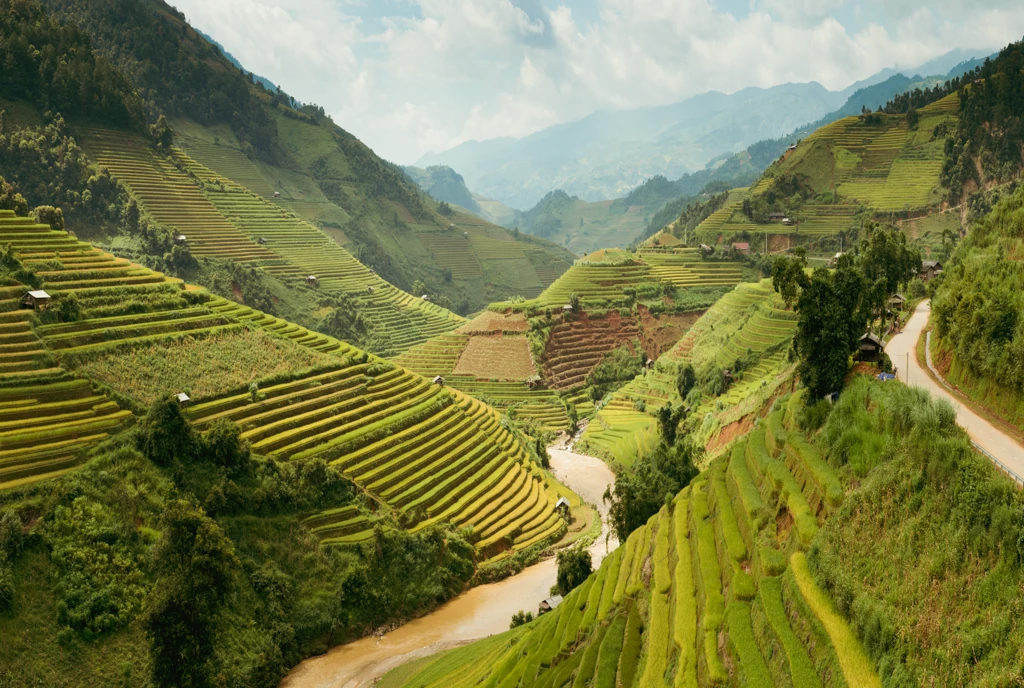
When shooting the terraces of Mu Cang Chai or Sapa, the temptation is to stay wide. However, a 70-200mm or 100-400mm lens is often more effective. Telephoto compression allows you to "stack" the layers of the terraces, highlighting the mathematical beauty of the curves and isolating ethnic minority farmers against the vast landscape.
Floating Markets: The Mid-Range Hustle
On the Mekong’s floating markets, you are shooting from a moving boat at another moving boat. Light changes rapidly as the sun rises. A 24-105mm f/4 is the "Swiss Army Knife" for this environment. It’s wide enough to capture the scale of the river and long enough to grab a tight portrait of a merchant tossing a pineapple across the water.
Mountain Portraits: The Environmental Prime
In the northern highlands, portraits are most powerful when they show the relationship between the person and the terrain.An 85mm f/1.8 provides beautiful separation, but a 50mm or even a 35mm allows you to keep the mountains or the texture of a traditional wooden house in the frame, providing essential narrative depth.
Weather Considerations: Managing the Elements
Vietnam’s climate can be brutal on electronics. Professional-grade weather sealing is helpful, but it is not a complete solution.
Humidity and the "Fog-Out"
The most common technical failure is lens fogging. When moving from a highly air-conditioned hotel or car into the tropical heat, moisture will instantly condense on your glass—internally and externally.
- The Strategy: Place your gear in your bag and set it outside (on a balcony or in a non-AC hallway) 30 minutes before you plan to shoot. This allows the internal temperature of the glass to equalize with the dew point.
Rain Protection
The monsoon is not a reason to stop shooting; it is a reason to gear up. While "rain sleeves" are useful, a simple heavy-duty dry bag inside your backpack is more reliable during a sudden tropical downpour. Always carry several microfiber cloths in a dedicated waterproof pouch to wipe salt spray or rain off the front element.
Dust in the Highlands
During the dry season in the Central Highlands (Tay Nguyen) or the far North, fine red dust is pervasive.
- The Strategy: Avoid changing lenses in the field. If you must, do it inside your bag or under a jacket. Use a rocket blower daily to clean your sensor; avoid using canned air, as the pressure can be too high for delicate internal components.
Drone Usage: The 2026 Realities
As of 2026, Vietnam has clarified its drone regulations under Decree 288/2025/ND-CP. Navigating these is essential to avoid heavy fines or equipment confiscation.
- The 250g Rule: Drones under 250g (such as the DJI Mini series) are generally exempt from flight permits for personal use, provided you stay outside of restricted "Red Zones."
- Permit Requirements: For drones over 250g or any commercial work, a permit from the Ministry of National Defense is required. Applications must be submitted at least 14 days in advance and must specify exact flight coordinates and dates.
- Prohibited Areas: Military bases, border zones, and government buildings are strictly off-limits. Most of the Ha Giang loop is considered a sensitive border area; fly with extreme caution and local advice.
Power and Data Redundancy on the Move
In remote areas of Lao Cai or Ha Giang, power can be intermittent, and internet speeds are rarely sufficient for cloud backups.
Power Management
Modern mirrorless cameras are power-hungry. In the mountains, cold nights can drain lithium batteries faster than expected.
- The Strategy: Carry a minimum of three batteries per body. Invest in a high-capacity power bank (20,000mAh+) that supports USB-C PD (Power Delivery) to charge your camera or laptop in transit. In homestays, outlets are often limited; bring a small travel power strip or a multi-port USB charger.
Data Redundancy: The "3-2-1" Rule
Do not rely on a single laptop or a single SD card.
- In-Camera: Use cameras with dual card slots. Set them to "Backup Mode" so every image is written to two cards simultaneously.
- On-Site: At the end of every day, transfer images to a rugged SSD.
- Redundancy: Copy that SSD to a second, identical drive. Keep these two drives in separate bags (e.g., one in your camera bag, one in your checked luggage) during travel.
The Road Workflow: Editing in the Field
Editing while traveling in Vietnam requires a balance of speed and battery conservation.
Culling Over Editing
Don't try to finish every photo on the road. Use your time in cafes or on long bus rides to cull. Flag your "keepers" and delete the technical failures. This reduces the amount of data you need to manage and makes the final editing process at home much less daunting.
Smart Previews
If you use Adobe Lightroom, build Smart Previews on import. This allows you to edit and rank your photos without having your heavy external drives plugged in, which significantly saves laptop battery life—a crucial factor when power outlets are unavailable.
Conclusion: Why Gear Matters Less Than Timing
You can have the most expensive medium-format system in the world, but if you arrive at the Cai Rang floating market at 9:00 AM, you’ve already failed. In Vietnam, access and timing are the ultimate "gear."
Technical proficiency and the right kit are simply the floor; they ensure that when the "decisive moment" happens—the sun hitting a specific terrace at 6:14 AM or a monk’s expression in a shaft of temple light—you aren't fiddling with a fogged lens or a dead battery.
Build a kit that is robust enough to survive the humidity but light enough to let you climb that last hill. In the end, the best gear strategy for Vietnam is the one that disappears, leaving only you and the frame.