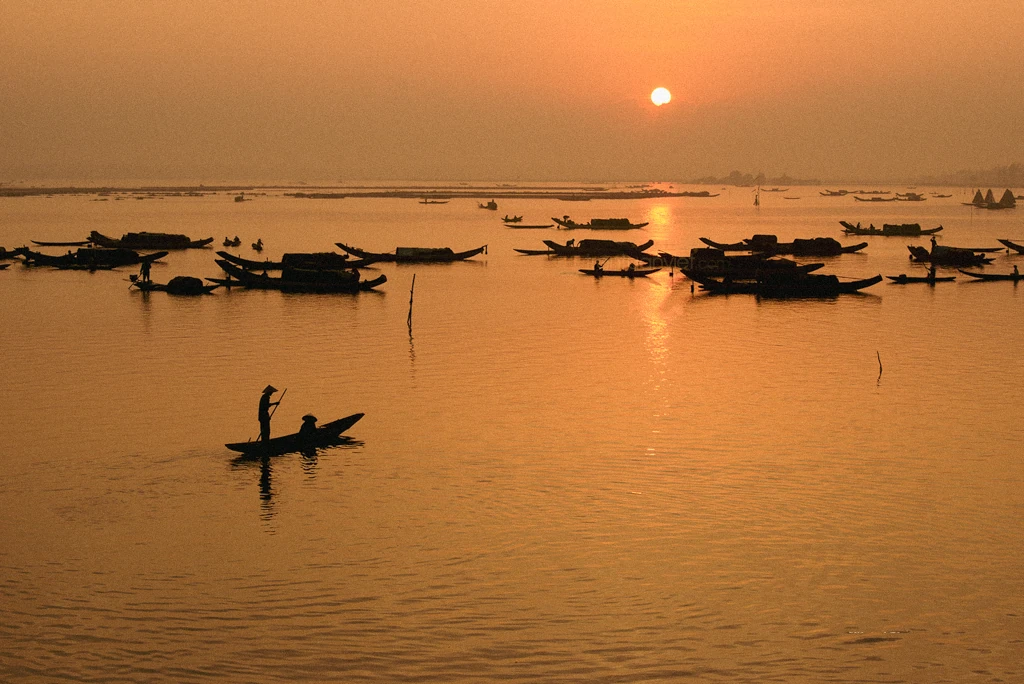
For the landscape and documentary photographer, the day in Vietnam is bookended by two vastly different optical realities. While the amateur might view sunrise and sunset as interchangeable periods of "golden hour," the professional recognizes that in the tropics, the atmosphere behaves differently at 6:00 AM than it does at 6:00 PM.
In Vietnam, factors such as overnight condensation, particulate matter buildup (haze), and localized wind patterns create distinct visual signatures. Choosing between a 4:30 AM wake-up call and a late-evening vigil is not just a matter of scheduling; it is a strategic decision that dictates the clarity, color temperature, and emotional weight of your imagery.
1. The Atmospheric Physics of the Vietnamese Day
To choose your light, you must first understand the medium through which it travels. Vietnam’s high humidity and topographical variety create specific "optical windows."
The Morning Clarity: Condensation and Settlement
During the night, the temperature drop causes moisture in the air to condense, often resulting in ground mist or fog, particularly in the North and Central Highlands. More importantly, urban dust and agricultural smoke tend to settle overnight.
- The Result: Sunrise typically offers the highest micro-contrast and the cleanest "clean air" views. If your goal is to capture the distant peaks of the Hoàng Liên Sơn range or the crisp skyline of Ho Chi Minh City, the morning is your ally.
The Evening Haze: Particulate Buildup
As the day progresses, convection currents lift dust, vehicle emissions, and smoke from charcoal braziers into the atmosphere.
- The Result: Sunset in Vietnam is frequently characterized by a "thick" horizon. This haze scatters shorter blue wavelengths, resulting in deeper reds and oranges, but at the cost of background detail. Sunset is often "moodier" but "messier."
2. Regional Breakdown: Where Timing Matters Most
The Northern Highlands (Terraces and Peaks)
In places like Mù Cang Chải and Sapa, the topography creates "micro-climates" that favor the morning.
- Sunrise (The Superior Choice): The mountains are prone to "valley fog" that burns off by 9:00 AM. Photographing the terraces at sunrise allows you to capture the sun breaking through the mist, creating "god rays" that define the layers of the landscape.
- Sunset: By late afternoon, the valleys often fill with a flat, grey haze. Unless there has been a heavy afternoon rain to "wash" the air, sunset in the mountains often lacks the dramatic depth of the morning.
The Coast (Hạ Long Bay and Central Vietnam)
Because Vietnam’s coastline is primarily East-facing, the "geometry of light" is lopsided.
- Sunrise: This is the hour of the "Direct Light." In Hạ Long Bay, the sun rises from the sea, backlighting the limestone karsts and creating dramatic silhouettes.
- Sunset: You are shooting into the "Glow." The sun sets behind the land, meaning the sea and the islands are illuminated by soft, reflected light. This is the time for long exposures and pastel palettes (pinks and purples) rather than the fiery oranges of sunrise.
The Urban Centers (Hanoi and Saigon)
- Sunrise (The Social Documentary): This is the most authentic time for street photography. The light is cool, and the "Invisible Workforce" is in full swing. Hanoi’s Hoàn Kiếm Lake at 5:30 AM offers a soft, blue-gold light that is perfect for capturing the rhythm of tập thể dục (morning exercise).
- Sunset (The Cinematic City): This is when the city's artificial lights begin to compete with the fading sun. The "Blue Hour" in Saigon is spectacular for capturing the trail of motorbike lights against the backdrop of the Bitexco Tower.
3. Technical Strategy: Exposure and Optics
The technical requirements for sunrise and sunset are not identical, primarily due to the direction and "weight" of the light.
Exposure Strategy: The Dynamic Range Challenge
- Sunrise: You are often dealing with rapidly increasing brightness. Meter for the highlights of the sun’s disc. In the mountains, use a Graduated Neutral Density (GND) filter (0.9 or 3-stop) to hold back the sky while revealing the detail in the dark, shadowed valleys.
- Sunset: The light is dying. This is the realm of the tripod and long exposure. As the light levels drop, you can use slower shutter speeds to blur the movement of river water in Hội An or the flow of traffic in Hanoi, creating a sense of time passing.
Lens Recommendations
- Sunrise: A Telephoto (70-200mm or 100-400mm) is essential for "compressing" the morning mist and stacking the mountain layers.
- Sunset: A Wide-Angle (16-35mm) is often better for capturing the expansive "glow" of the sky and the reflections on the water, especially in the Mekong Delta or coastal lagoons.
Color Temperature Management
- Sunrise: The light starts "cool" (blue) and moves toward "warm." Set your White Balance to 5000K to preserve the delicate early-morning blues.
- Sunset: The light moves from "warm" to "deep red." Set your White Balance to 6500K (Cloudy) to enhance the fiery tones of the Vietnamese horizon.
4. The Decision-Making Framework: Which to Choose?
If you have only one day in a location, use this logic to decide where to spend your energy.
| Goal | Primary Choice | Why? |
| Mountain Vistas | Sunrise | To capture valley mist and avoid afternoon haze. |
| Street Life | Sunrise | For authentic "start of day" energy and soft side-light. |
| Cityscapes | Sunset | To utilize the blend of natural "Blue Hour" and neon lights. |
| Reflections (River/Sea) | Sunset | Soft, indirect light minimizes "hot spots" on the water. |
| Architecture | Sunrise | Clearer air allows for sharper detail in historical textures. |
5. Planning and Logistics: The "Fatigue Factor"
Professional photography in Vietnam is a grueling physical endeavor. Managing your energy is as important as managing your ISO.
The Sunrise Grind
A 4:30 AM start in Vietnam usually means a 3:30 AM wake-up.
- Logistics: Always arrange your transport (motorbike taxi or private car) the night before. In rural areas, the "Grab" app will not work at 4:00 AM.
- The "Dip": After the sunrise shoot (approx. 8:30 AM), you will experience a significant energy crash. Strategic Nap: Schedule a 90-minute sleep from 11:00 AM to 12:30 PM. This is when the light is at its most "un-photographable" (overhead and harsh).
The Sunset Vigil
Sunset photography in Vietnam often merges into "Night Photography," especially in cities.
- Logistics: Scout your location during the day. Know exactly where the sun will drop. Apps like PhotoPills or The Photographer's Ephemeris are indispensable for calculating the sun's trajectory over specific landmarks like the Long Biên Bridge.
6. Case Studies: Field Examples
Case Study A: The Terraces of Mù Cang Chải
- Strategic Choice: Sunrise.
- The Reason: At sunset, the sun drops behind the high ridges, putting the terraces into deep shadow long before the sky turns red. At sunrise, the light grazes the ridges, highlighting the rims of the water-filled paddies.
Case Study B: The Thu Bồn River, Hội An
- Strategic Choice: Sunset.
- The Reason: The river runs East-West. At sunset, the low sun illuminates the yellow facades of the old houses along the waterfront. The transition into the "Lantern Hour" immediately follows, allowing for a two-for-one shooting session.
Case Study C: Ha Long Bay
- Strategic Choice: Sunrise for Silhouettes; Sunset for Textures.
- Field Note: Most cruises anchor in a way that favors one or the other. Ask the captain where the "overnight anchorage" is to determine if you will have a clear view of the eastern horizon.
7. Safety and Ethics
- Respecting the Silence: During sunrise shoots in villages, remember that while you are "at work," the locals are starting their day. Avoid using flash in residential areas and keep noise to a minimum.
- Personal Safety: When shooting sunset in urban areas, be mindful of your surroundings. "Snatch and grab" thefts of cameras can occur in crowded areas like Saigon’s bridges. Use a sturdy neck strap and keep your gear bag between your legs.
8. Conclusion: The Master of the Clock
In Vietnam, the light is a fleeting gift. The difference between a "good" photo and a "world-class" photo often comes down to a photographer's willingness to understand the atmospheric conditions of the hour.
Sunrise is the hour of Clarity, Labor, and the Sublime. It is for the photographer who seeks to document the soul and the structure of the land.
Sunset is the hour of Mood, Motion, and the Modern. It is for the storyteller who wants to capture the city’s energy and the sky’s final, dramatic bow.
By choosing your "light window" based on regional atmospheric data rather than convenience, you ensure that your portfolio reflects the true, complex beauty of the Vietnamese day.