
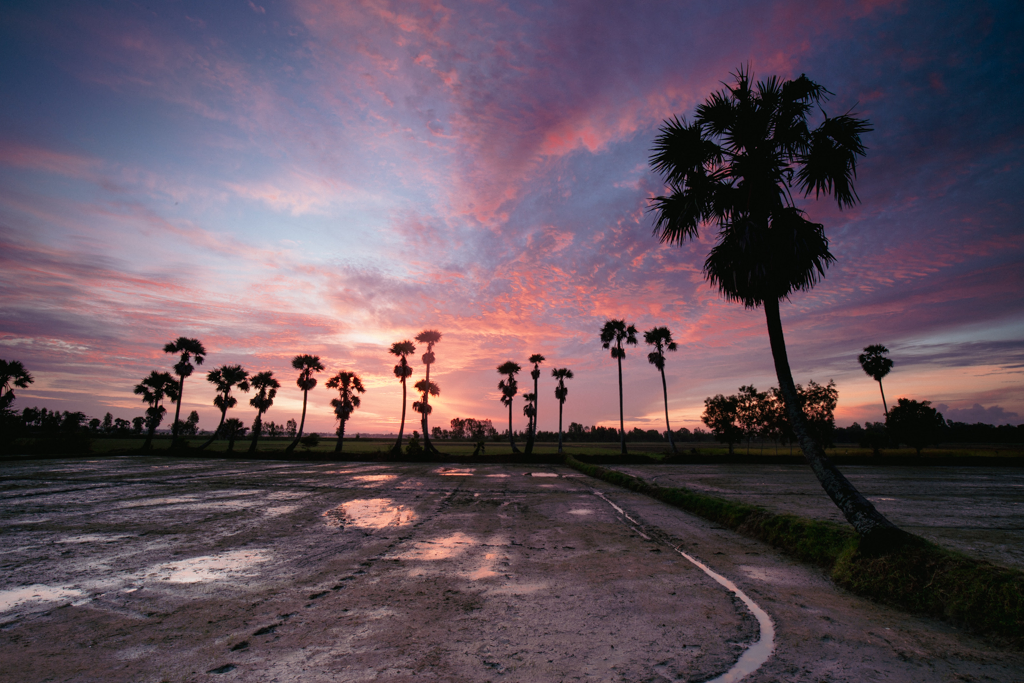
To capture the Mekong Delta effectively, you must think like a documentary filmmaker rather than a casual traveler. Mekong Delta is a landscape where land and water are indistinguishable, a sprawling amphibious world where the rhythm of life is dictated by the tides of the Nine Dragon River. For the serious photographer, the challenge is rarely finding a subject—the Delta is an embarrassment of riches—but rather the logistical execution required to be in the right light, at the perfect angle, on a vibrating, moving boat.
The Mekong is not a “pretty” river in the traditional sense. It is a working river. It is silt-brown, opaque, and muscular. But for those who understand how to use that silt as a reflective medium, and how to navigate the social complexities of the floating markets, the Delta offers a level of visual storytelling that is increasingly rare in the modern world.
The Veins of Vietnam: Understanding the Riverine Canvas
The geography of the Delta is your first instructor. As the Mekong flows from Tibet and through the heart of Southeast Asia, it finally shatters into two main branches in Vietnam: the Tien River (Upper River) and the Hau River (Lower River). These further splinter into a labyrinth of nine mouths and thousands of “rạch” (canals).
For photography, this geography means the background is never static. You are almost always shooting from a low-angle sampan, looking up at stilt houses or into the cavernous, high-set hulls of wholesale barges. The water is a permanent, silt-brown reflector. It bounces warm, earthy light upward, acting like a giant natural gold reflector. This is particularly useful for portraits; when a vendor wears a traditional “nón lá” (conical hat), the sun usually casts a deep shadow over their face. However, the river’s reflection fills those shadows with a soft, warm glow that no strobe could ever replicate.
View our: Photography Tour in Mekong Delta region.
The Hierarchy of Destinations: Where to Point Your Lens
While the entire Delta is photogenic, five specific hubs offer the most concentrated opportunities for a professional-grade portfolio.
Can Tho: The Commercial Pulse As the largest city in the Delta, Can Tho is your logistical base camp. It offers the best infrastructure for hiring private, high-speed photography boats. While the city itself is modernizing, its proximity to the Cai Rang and Phong Dien markets makes it indispensable.
Long Xuyen: The Documentary Choice If you find Can Tho too polished, Long Xuyen is your antidote. It is significantly less “touristy,” offering a grittier, more authentic floating market experience. Here, you’ll also find incredible access to the Chau Doc border region, where Cham Muslim villages on stilts and floating fish farms provide distinct cultural textures that differ wildly from the ethnic Kinh (Vietnamese) heartland.
Sa Dec: The Colonial and Floral Aesthetic Famous as the setting for Marguerite Duras’s The Lover, Sa Dec is a study in color and colonial architecture. It is home to massive floral villages where gardeners grow flowers on raised platforms above water to protect them from floods. The sight of farmers navigating small boats between rows of marigolds and chrysanthemums is a visual feast that peaks during the weeks leading up to the Lunar New Year.
Ben Tre: The Coconut Kingdom This is the premier location for “slow photography.” Ben Tre’s narrow, palm-shaded canals are tight and intimate. It is the best place to capture the interplay of light and shadow in dense coconut groves and the hauntingly beautiful traditional brick kilns that line the banks of the Ham Luong River.
Tra Vinh: The Khmer Influence Tra Vinh feels like a different country. With over 140 Khmer pagodas, the architecture shifts from Vietnamese minimalism to ornate, Angkor-style grandeur. It is the best spot in Vietnam for photographing monks in saffron robes against the backdrop of intricately carved temples.
Floating Market Strategy: Beyond the Tourist Boat
Floating markets are not static events; they are chaotic, fast-moving trade zones. If you show up on a slow tourist boat, you will be trapped in the “tourist lane,” far from the action.
The Markets and Their Personalities Cai Rang is about scale. It’s a wholesale market where massive barges trade in bulk. It’s the place for wide-angle shots showing the sheer volume of commerce. Phong Dien, by contrast, is intimate. It is dominated by small sampans, many still paddled by hand. This allows for closer-range shooting and more personal interactions. Long Xuyen remains the most authentic; it lacks the “breakfast boats” selling noodles to tourists, offering raw documentary opportunities of families who live, sleep, and eat on their vessels.
The “Bẹo” Pole Detail Every wholesale boat in the Delta has a “cây bẹo”—a long bamboo pole with a sample of their cargo tied to the top (a pineapple, a pumpkin, a bunch of turnips). This is the market’s “billboard.” A quintessential Mekong shot involves using a telephoto lens to isolate these hanging goods against the soft, hazy morning sky. It is the perfect visual metaphor for the region’s trade.
Positioning and Logistics You must be on the water by 5:00 AM. The “Golden Hour” here is fleeting; by 8:30 AM, the equatorial sun creates a harsh haze and the most intense trading activity begins to wind down. Instruct your boat pilot to pull alongside the large barges rather than circling them. The best shots are often looking into the cabin of a barge, where three generations of a family might be sitting together, or capturing the frantic exchange of money and produce between two rocking vessels.
Rural Industry: Documenting the Delta Interior
The heart of the Delta isn’t just on the water; it’s in the vườn (orchards) and lò (workshops) that line the banks.
The Red Pyramids of Mang Thit The brick kilns of the Mang Thit district are among the most striking architectural subjects in Vietnam. These massive, beehive-shaped structures are built from local clay and fired with rice husks.
- The Strategy: Go inside a kiln that is currently being stacked or emptied. The geometry is staggering. Use a wide-angle lens (16-35mm) to capture the “oculus” light falling from the hole at the top of the dome. The dust from the rice husks catches the light beams, creating a “cathedral” effect.
Coconut Processing in Ben Tre In the workshops of Ben Tre, workers process thousands of coconuts a day with rhythmic, machine-like speed.
- The Strategy: Focus on the hands. The contrast between the rough, textured husks and the sharp, gleaming machetes makes for a powerful documentary study. This is an environment that screams for high-contrast black-and-white processing.
Technical Execution: Shooting from a Moving World
Photography in the Delta is a battle against vibration and humidity.
Mastering the Shutter Speed Even if the water looks calm, your boat is not. Between the vibration of the “long-tail” diesel engines and the wake from passing barges, your platform is constantly micro-shaking. Never drop your shutter speed below 1/500s, even in the dim light of dawn. Raise your ISO to compensate. A slightly grainy image is fixable; a motion-blurred image is a tragedy.
The Stabilization Paradox While In-Body Image Stabilization (IBIS) is a godsend, do not use a tripod on a small boat. The tripod will act as a lightning rod for the engine’s vibrations, transferring them directly to your sensor. Instead, use your body as a shock absorber. Brace your elbows against your ribs and keep your knees slightly bent to absorb the roll of the river.
Lens Selection for the River
- The 24-70mm f/2.8: This is your workhorse. It’s wide enough for the river landscapes and tight enough for environmental portraits.
- The 70-200mm f/2.8: Essential. In a floating market, you often can’t get as close as you’d like without disrupting the trade. This lens allows you to compress the scene, making the boats look packed together, and lets you capture candid moments from a respectful distance.
- The 35mm Prime: Keep this for the “blue hour” or for shooting inside the dark, cramped cabins of the barges.
Portraiture Ethics and the “Nod and Smile”
The people of the Mekong Delta are famously hospitable—perhaps the most welcoming in all of Vietnam. However, the “hit-and-run” style of street photography, where you snap a photo and bolt, is seen as disrespectful.
The Social Contract Before raising your camera, make eye contact. A simple “Xin chào” or a nod goes a long way. If they are busy working, wait for a natural break in their rhythm. The people here are proud of their work; if you show interest in what they are doing—whether it’s peeling a pineapple or weaving a mat—they will almost always allow you to photograph them.
The Hero Angle vs. The Peer Angle Because you are often sitting in a low sampan, you are physically lower than the people on the larger barges or the riverbanks. This creates a “heroic” low-angle perspective. While this can be powerful, it can also feel distant. If possible, step onto the larger barges (with permission). Getting on the same physical level as your subject creates a sense of intimacy and peer-to-peer storytelling that defines high-end documentary work.
Seasonal Narratives: When the Delta Transforms
The Delta is a chameleon. Depending on when you visit, you are photographing a completely different world.
The Floating Season (August – November) This is the most photogenic time of the year. The Mekong overflows its banks, turning the rice fields of An Giang into giant mirrors. This is the only time you can photograph the water lily harvest, where women in conical hats wade through chest-deep water, their colorful “áo dài” reflected in the still surface. This is also the peak time for drone photography, as the “mirror effect” of the flooded fields is breathtaking from above.
The Fruit Season (June – August) If you want color and energy, this is your window. The orchards are heavy with fruit, and the floating markets are at their most vibrant, overflowing with the neon pink of dragon fruit, the spiked shells of durian, and the deep purple of mangosteen.
The Dry Season (December – April) The light is at its most predictable—crisp, blue skies and reliable golden hours. However, be aware that some of the smaller, “Instagrammable” canals in Ben Tre may become too shallow for boats to navigate, so you’ll need to stick to the main tributaries.
Advanced Drone Tactics for the Delta (2026 Edition)
In 2026, drone technology has made aerial storytelling accessible, but the Delta remains a high-risk environment for flight.
Hand-Launching and Catching The banks of the Mekong are often thick with mangroves or mud, making a flat landing zone impossible. You must master the art of hand-launching and hand-catching from a moving boat.
- Crucial Tip: Always set your “Return to Home” (RTH) point to the Controller/Remote Location, not the “Take-off Point.” If you leave it at the take-off point, and your boat has drifted 500 meters downstream, your drone will dutifully attempt to land in the middle of the river where your boat used to be.
The Humidity Factor The air in the Delta is thick with moisture. In the early morning, this can lead to lens fogging on your drone’s gimbal. Power on your drone and let it sit for five minutes before taking off to allow the internal components to warm up and clear any condensation.
Logistics and the Unseen Opportunities
To get professional results, avoid the “tourist experience” at all costs.
Hire Private, Not Group Go to the piers (like Ninh Kieu in Can Tho) at 4:30 AM. Negotiate directly with a local captain. Look for a captain with a “sampan” (traditional small boat) rather than a large motorized tourist vessel. You want to be close to the water. Expect to pay a premium—roughly 600,000 to 1,000,000 VND—for a 4-5 hour trip that allows you to dictate the stops and the speed.
The Magic of the “Phà” (Ferries) One of the most overlooked photography spots in the Delta is the river ferry. As bridges replace the old ferry routes, these are becoming a vanishing part of Vietnamese life. Standing on a crowded ferry at sunset, surrounded by hundreds of commuters on motorbikes, provides a fantastic opportunity for “compressed” street-style photography. The light hitting the river through the ferry’s open deck is often spectacular.
Weathering the Elements: Gear Protection
The Mekong is a harsh environment for electronics. Between the spray from the river and the sudden tropical downpours, you need a protection strategy.
The Humidity Battle Moving from an air-conditioned car or hotel room into the 95% humidity of the river will instantly fog your lenses. This fog can sometimes form inside the lens elements.
- The Solution: Keep your camera gear in the trunk of the car (where it’s warmer) rather than the air-conditioned cabin, or leave your camera bag on the hotel balcony (if secure) for 30 minutes before you head out.
Salt and Silt While the Mekong is freshwater, the lower reaches near the coast can have high salinity. Always wipe down your gear with a damp cloth at the end of the day to remove any dried silt or salt spray that can corrode the metal contacts and rubber grips of your camera.
The Editing Philosophy: Earth, Water, and Skin
When you sit down to edit your Mekong Delta series, aim for a “National Geographic” realism rather than a hyper-saturated “travel blogger” look.
The Silt Palette Don’t try to make the water look blue. It isn’t blue. Embrace the browns, the tans, and the ochres. Use the Calibration panel in Lightroom to subtly shift your shadows toward a warmer tone, which complements the river’s reflection.
Skin Tones and the Nón Lá Because of the conical hats, the eyes of your subjects will often be in deep shadow. Use a Radial Filter or the Subject Selection tool to subtly lift the exposure on the eyes and faces, but keep the shadows under the hat brim believable.
Taming the Tropical Greens The jungle greens of the Delta can be overwhelming and “neon.” Shift your Green hues toward the Yellow/Orange side to give the foliage a more organic, earthy feel that ties in with the river water.
Final Thoughts: The Quiet Moments
The Mekong Delta is a test of a photographer’s ability to find silence in the noise. Between the roar of the diesel engines, the shouting of the traders, and the splashing of the brown water, it is easy to get overwhelmed.
But if you watch closely, you’ll see the quiet moments: a child napping in a hammock strung across a fruit barge; a woman meticulously arranging flowers on a sampan; the way the smoke from a riverside kitchen catches the last light of the day.
The Delta doesn’t want to be “captured.” It is a living, breathing entity that is constantly in flux. Your job is to be a ghost in the machine—moving with the tide, respecting the rhythm, and organizing the beautiful chaos into a single, silent frame.