
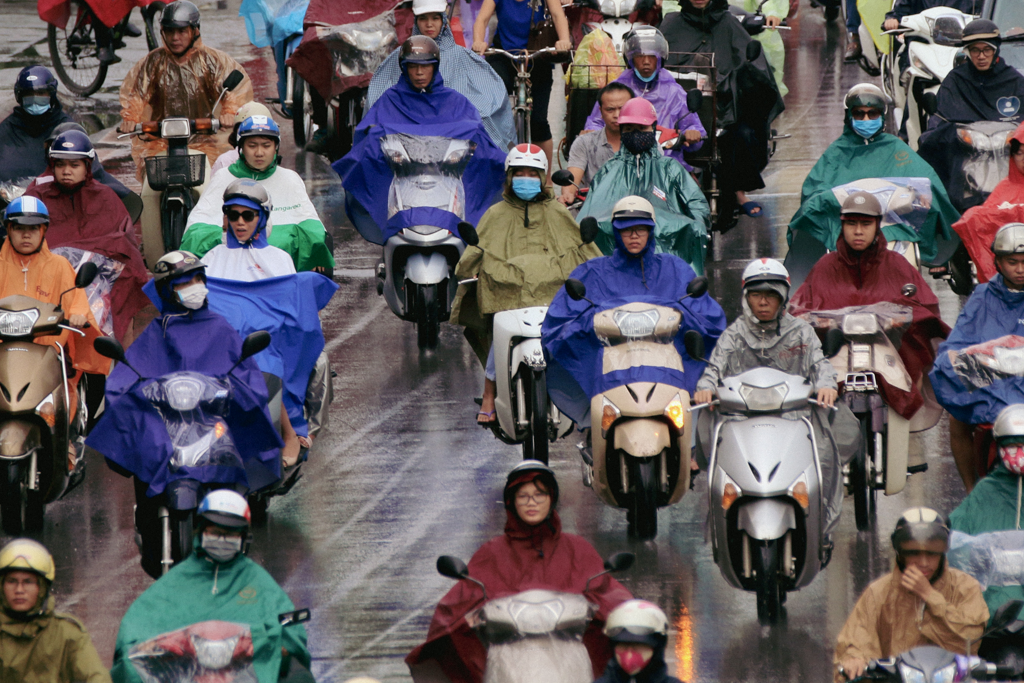
The Art of the Organized Chaos: A Definitive Photographer’s Guide to Hanoi
Hanoi does not offer itself up easily. Unlike the cinematic, sweeping vistas of the Northern Highlands or the curated, lantern-lit charm of Hoi An, Vietnam’s capital is a relentless, sensory assault. It is a city that feels like it’s being held together by a billion tangled power lines and the sheer collective will of eight million motorbikes. For the uninitiated photographer, the first instinct is to point the camera at everything. The result is almost always a cluttered frame that fails to capture the soul of the place.
To photograph Hanoi effectively, you must graduate from being a tourist with a camera to being a visual editor. The secret to a premium Hanoi portfolio isn’t addition; it’s subtraction. You aren’t just documenting the chaos—you are organizing it into a narrative. This is a city of layers, where a thousand years of Chinese occupation, French colonialism, and Soviet-era pragmatism are stacked on top of one another like a vertical jigsaw puzzle. If you can learn to see through the clutter, Hanoi reveals itself as one of the most rewarding street photography destinations on the planet.
The Three Visual Dialects of the City
Before you even charge your batteries, you have to understand that Hanoi is not one city, but three distinct visual identities existing in the same space. A sophisticated portfolio needs to touch on all three to feel complete.
The first is the Old Quarter (Hoan Kiem). This is the heartbeat. It is a medieval labyrinth of “tube houses”—narrow, deep buildings designed to evade historical property taxes based on street frontage. Here, the visual language is one of compression. The streets are named after the crafts once practiced there: Silver Street, Tin Street, Hemp Street. The photography here is about human rhythm. It’s the steam rising from a morning Pho bowl, the sparks from a welder’s torch on a sidewalk, and the way light filters through the “tangled crown” of overhead wires.
The second layer is the Colonial Legacy. Just south of the Old Quarter, the streets widen into the French Quarter. The architecture shifts to grand, ochre-colored villas, shuttered windows, and the symmetry of the Opera House. This area offers a different geometric challenge. The colors are muted, the shadows are longer, and the vibe is decidedly “Little Paris” seen through a humid, Southeast Asian lens.
Finally, there is the Socialist and Modern Transition. To find the gritty, authentic soul of Hanoi, you must look toward the Khu tập thể—the massive, Soviet-style collective housing blocks built in the mid-20th century. These buildings, with their weathered concrete and “tiger cage” balcony extensions, represent a bridge between the city’s revolutionary past and its hyper-capitalist future. They are masterpieces of texture and brutalist geometry.
The Philosophy of the Hanoi Layer
If there is one technical concept to master in this city, it is layering. Because Hanoi is so dense, a flat image—one where the subject is simply placed against a wall—feels incomplete. It lacks the “squeeze” of the city.
A premium Hanoi image requires three distinct planes of focus. First, the foreground: perhaps the blurred handlebars of a passing scooter or the edge of a hanging silk banner. This gives the viewer a sense of being in the street. Second, the midground: this is your “hero,” the primary subject of your story. It might be a fruit vendor adjusting her conical hat or a barber leaning against a century-old tree. Third, the background: here, you look for the city’s DNA—a faded revolutionary poster, a yellow colonial wall, or a stack of blue plastic stools.
By mastering the “frame within a frame” technique—shooting through doorways, between parked bikes, or under the eaves of a temple—you create dimensionality. You turn a crowded street into a structured stage.
Mastering the Light: A Seasonal Narrative
Hanoi’s light is temperamental. It changes not just by the hour, but by the season, dictating the mood and the color palette of your work.
The Golden Window (October to December) This is the photographer’s dream. The brutal humidity of summer breaks, replaced by a crisp, dry air that clears the smog. The sun hangs lower in the sky, casting long, dramatic shadows across the Old Quarter’s narrow alleys. In the early mornings, a soft haze often settles over the lakes, acting as a natural diffuser. This is the best time for high-contrast street photography, where you can play with “chiaroscuro” effects—bright subjects emerging from deep, dark alleyways.
The Pastel Phase (February to April) During the “Tet” (Lunar New Year) season, Hanoi is often shrouded in mưa phùn—a fine, misty drizzle. To the average traveler, it’s annoying. To the photographer, it’s a gift. The light becomes perfectly flat and soft, creating a painterly, pastel atmosphere. Skin tones look incredible in this light, making it the premier season for environmental portraiture. The colors of the city—the faded yellows and mossy greens—take on a saturated, filmic quality that you simply can’t get in harsh sunlight.
The Cinematic Monsoon (May to September) The heat is punishing, and the light can be “white-hot” and unflattering during the day. However, the late afternoon thunderstorms change everything. When the sky breaks, the city is washed clean. The wet asphalt becomes a mirror for neon signs and brake lights. If you are chasing a “Cyberpunk” or “Mood” aesthetic, the rain is your best friend. A shot of a lone cyclist in a colorful poncho, reflected in a deep puddle against the backdrop of the St. Joseph Cathedral, is a quintessential Hanoi masterpiece.
The Technical Toolkit: Gear and Settings
In a city as fast and cramped as Hanoi, your gear needs to be an extension of your body.
The Lens Choice While it’s tempting to bring a wide-angle zoom to “get it all in,” you will often find that a 16mm or 24mm lens captures too much clutter. The 35mm prime (full-frame equivalent) is the undisputed king of Hanoi. It is wide enough to capture the environment but tight enough to provide a sense of intimacy.
If you want to isolate subjects in the chaos, a 50mm or 85mm prime is essential for “cleaning up” the background. A telephoto zoom (like a 70-200mm) is surprisingly useful for “compression”—making the sea of motorbikes look like a solid wall of color, or capturing the intricate steel latticework of the Long Bien Bridge from a distance.
The Street Settings Hanoi is a high-speed environment. To keep up, use Aperture Priority with a “Minimum Shutter Speed” set in your ISO sensitivity settings. Aim for at least 1/250s to freeze the movement of pedestrians and slow-moving bikes.
For the Old Quarter, an aperture of f/4 or f/5.6 is often better than shooting wide open. You want the background to be slightly out of focus, but still recognizable as “Hanoi.” If you blur the background into total “bokeh” mush, you lose the context that makes the city special.
Zone Focusing In the tightest alleys, even the fastest autofocus can hunt. Many pro street photographers in Hanoi switch to manual focus, setting their lens to a “zone” (e.g., 2 meters) and using a smaller aperture (f/8) to ensure everything within that range is sharp. This allows you to shoot from the hip or react instantly to a passing moment without waiting for a focus confirmation beep.
The Geography of the Lens: Key Locations
Long Bien Bridge: The Eiffel of the East Designed by the same firm that built the Eiffel Tower, the Long Bien Bridge is a skeletal masterpiece of rusted iron. It survived the bombings of the Vietnam War and stands today as a symbol of resilience.
- The Strategy: Arrive at sunrise. The bridge is a hive of activity as farmers bring produce into the city on overloaded bicycles. Use the leading lines of the tracks and the repetitive geometry of the steel beams to create depth. The pedestrian walkway is narrow, so be mindful of traffic.
Hoan Kiem Lake: The Morning Ritual Between 5:30 AM and 7:00 AM, the lake is the city’s communal living room. You will see elderly groups practicing Tai Chi, joggers, and even ballroom dancing.
- The Strategy: Focus on the human element. The soft morning mist over the water provides a clean background for silhouettes. It is the one place in the city where you can find “quiet” compositions.
The “Khu Tập Thể” (Old Collective Housing) For a deep dive into the “real” Hanoi, head to areas like Nguyen Cong Tru or Thanh Xuan. These apartment blocks are visual goldmines. Look for the “tiger cages”—iron-grated balcony extensions that hang precariously over the streets.
- The Strategy: Look for the interaction between the rigid, gray Soviet architecture and the vibrant, messy life of the people living within it. Shoot from the interior stairwells to capture the dramatic “light at the end of the tunnel” effect.
The Rails: Beyond the Hype “Train Street” has become a victim of its own success, often crowded and heavily policed. For a more authentic experience, follow the tracks toward the Long Bien Station. Here, you’ll find the same weathered buildings and narrow clearances but with actual neighborhood life—people drying clothes on the rails or kids playing between train arrivals. It feels lived-in, not staged.
Portraiture and the Ethics of the Street
Hanoi’s greatest asset is its people. The Hanoian spirit is one of industriousness and a surprisingly sharp wit. However, as a photographer, you must navigate the fine line between “documenting” and “exploiting.”
The “long-lens sniper” approach rarely works here. If you stand across the street with a 300mm lens, you miss the energy. The best portraits in Hanoi come from short interactions. A smile, a nod of the camera, or a “Xin chào” (hello) goes a long way.
If you are shooting at a market, buy something first. A ten-cent bunch of bananas or a coffee buys you the “right” to linger and shoot. If someone waves you away, respect it immediately. Hanoi is their home and workplace, not a zoo.
Look for the “Old Souls” of the city—the street barbers with their mirrors nailed to trees, the shoe repairmen on street corners, and the women balancing “don ganh” (bamboo yokes) on their shoulders. These are the faces that tell the story of Vietnam’s transformation.
The Cinematic Night: Neon and Steam
When the sun goes down, Hanoi’s color temperature shifts from the warm yellow of the walls to the cool blue of the moonlight and the harsh, vibrant pops of neon.
This is the time to embrace low-light storytelling. Head to the intersections of the Old Quarter where the food stalls are in full swing. The steam from the giant stockpots acts as a perfect medium for light, catching the glow of overhead lamps and creating a moody, atmospheric “haze.”
Handheld Technique You don’t need a tripod for night street photography if your camera has good In-Body Image Stabilization (IBIS). In fact, a tripod will only get in your way. Embrace a bit of motion blur. A shot of a motorbike blurred into a streak of red light while the background remains sharp communicates the “pulse” of Hanoi better than a perfectly frozen, static image.
Color Palette Night photography in Hanoi is all about the “Complementary Color” theory. The blue-hour sky (cool) contrasted with the warm orange glow of a Banh Mi stall (warm) creates instant visual appeal. Set your White Balance to “Tungsten” or “Fluorescent” to emphasize the blues, then “pull” the warmth back into the skin tones during post-processing.
The Digital Darkroom: The “Hanoi Look”
How you edit your Hanoi photos is just as important as how you shoot them. A “premium” look avoids the over-saturated, “HDR” style that many amateurs fall into.
The “Yellow” of History The iconic yellow of Hanoi’s colonial buildings is a very specific hue—it’s a mustard-ochre that has been weathered by decades of humidity and soot. In Lightroom, try pulling your Yellows slightly toward the Orange hue and dropping the Saturation. This gives the architecture a timeless, “National Geographic” feel.
Taming the Greens Vietnam is lush, and the greens can often be “neon” and distracting. Desaturating the greens and shifting their hue toward a more “forest” or “olive” tone helps the human subjects pop and prevents the image from looking too “digital.”
The Grit Factor Don’t be afraid of grain. Hanoi is a gritty city. Adding a subtle amount of film grain in post-processing can help unify the image, especially if you had to shoot at a high ISO in a dark alley. It leans into the “journalistic” aesthetic that suits this city so well.
Logistics for the Professional Eye
To get the most out of a photography trip to Hanoi, you need to manage your energy. This is a city that will wear you down if you aren’t careful.
Where to Stay Stay in the Old Quarter or the Truc Bach area. Being within walking distance of your subjects is vital for catching that 5:30 AM light. If you are a 15-minute taxi ride away, you will hit the morning rush hour and miss the “Blue Hour.”
Movement Download the Grab app (Southeast Asia’s Uber). A “Grab Bike” is the fastest way to get through traffic. It’s cheap, and it puts you right in the flow of the city, allowing you to scout locations as you ride.
The “Wait” Strategy The best street photographers in Hanoi don’t walk 20 miles a day. They find a “high-potential” corner—a spot with a beautiful yellow wall, good light, and an interesting foreground element—and they wait. They wait for the right person to walk into the frame. They wait for the “decisive moment.” In Hanoi, if you stay in one spot for 20 minutes, the whole world will eventually pass in front of your lens.
Common Mistakes to Avoid
- Shooting Too Wide: We’ve mentioned it before, but it bears repeating. A 16mm lens in the Old Quarter just captures a mess of power lines and half-cut-off motorbikes. Tighten up.
- Over-Editing: Avoid the “Clarity” slider. Hanoi already has enough texture. Too much “Clarity” or “Texture” in editing makes the photos look crunchy and amateur.
- Ignoring the Background: In the excitement of seeing a cool subject, photographers often forget to look at what’s behind them. A beautiful portrait is ruined by a plastic trash can or a distracting neon sign growing out of someone’s head.
- Rushing: Hanoi is a “slow-burn” city. Your best photos will likely come on day four or five, once your eyes have adjusted to the chaos and you start seeing the patterns instead of just the noise.
A Final Thought on the Soul of the City
Hanoi is not a city that will ever pose for you. It is indifferent to your presence. The motorbikes will not stop for your long exposure, and the vendors will not move their baskets so you can get a “cleaner” shot.
But that is exactly why it is so special. It is one of the few places left in the world where the culture hasn’t been entirely sanitized for the camera. It is raw, it is loud, and it is beautiful in a way that feels hard-earned. To photograph Hanoi well, you must fall in love with its imperfections. You must see the beauty in the rust, the rhythm in the traffic, and the dignity in the daily hustle.
When you finally stop trying to “fix” the chaos and start trying to understand it, that’s when the real magic happens. The city unfolds. The layers align. And you find that one frame that captures the thousand-year-old heartbeat of Vietnam.