
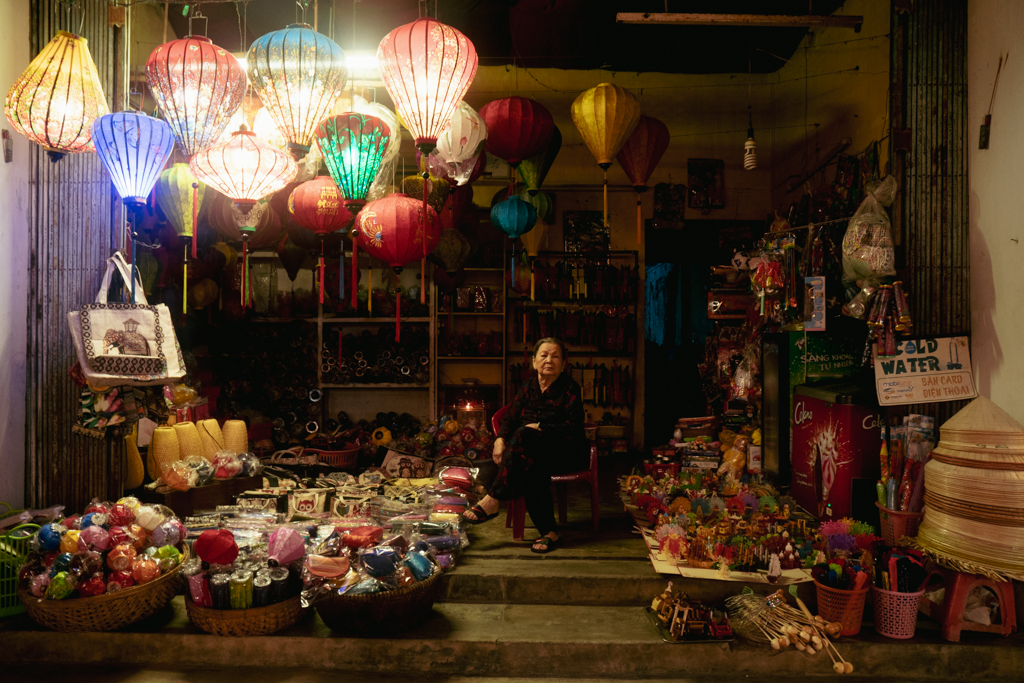
Here is an expanded, comprehensive masterclass guide. This version dives deeply into the philosophy, technical execution, and cultural nuances required to photograph Hoi An at a premium level, ensuring every paragraph delivers high-value insight.
Beyond the Lanterns: A Masterclass in Hoi An Photography
Hoi An is often described by travel writers as “easy.” Between the golden walls, the cascading silk lanterns, the mirrored reflections of the Thu Bon River, and the meticulously curated riverside cafés, the entire town appears pre-arranged for the camera. The architecture provides natural framing, the colors sit perfectly opposite each other on the color wheel, and the light reflects warmly off the centuries-old plaster.
That assumption is a dangerous trap.
Hoi An is incredibly easy to photograph superficially, but it is exceptionally difficult to photograph originally. Because the visual baseline is so high, it breeds laziness. When everything looks beautiful, the photographer stops hunting for composition and simply starts pointing the lens. To capture the Ancient Town with genuine depth, you must stop looking at it as a static postcard destination. You must start seeing it as a complex, layered visual system that demands rigorous timing, immense restraint, and tactical technical awareness.
This guide dismantles Hoi An piece by piece. It is designed not for the casual tourist, but for the dedicated photographer looking to cut through the visual noise and create a portfolio of substance, geometry, and atmosphere.
1. The Visual DNA: Decoding the Architecture and Palette
Before you even press the shutter, you must understand the visual language of the environment you are walking into. Hoi An is a miraculously preserved trading port dating back to the 15th through 19th centuries. Its architecture is an intricate collision of Vietnamese, Chinese, Japanese, and French colonial influences. But from a photographer’s perspective, the town is defined by three unyielding pillars.
The Geometric Triad The town is built on repeating patterns. Wooden rafters, symmetrical Chinese shopfronts, arched French doorways, and sloping yin-yang tiled roofs create a rigid geometric structure. When you shoot Hoi An, you are playing a game of alignment. If your lines are crooked, the image falls apart.
The Dominant Color Palette The town is governed by a highly saturated triad:
- Mustard Yellow: This is not a flat color. It is weathered, peeling, and textured by centuries of humidity and monsoon rain.
- Teal and Faded Green: Found on the heavy wooden shutters, doors, and balconies, providing a perfect complementary contrast to the yellow walls.
- Crimson Red: The color of the iconic silk lanterns that hang from nearly every awning.
The Density Challenge Hoi An’s final defining trait is its human density. The constant, sometimes overwhelming flow of tourist movement can ruin a carefully composed architectural shot. Your primary task in Hoi An is not simply to “capture” the town, but to ruthlessly control the visual clutter within your frame.
2. The Strategic Clock: Mastering the Light
Hoi An’s mood shifts violently with the rotation of the sun. Because the town is built on an east-west axis along the river, understanding the trajectory of the light is non-negotiable. To win in Hoi An, you must own the absolute fringes of the day.
The First Light (05:30 – 08:00 AM)
This two-and-a-half-hour window is the only time the town truly belongs to the photographer. The tourist crowds are asleep. The air is cool and occasionally mist-laden, particularly in the winter months.
- The Atmospheric Advantage: Local street vendors are quietly setting up their stalls, providing authentic, unforced human elements for your compositions.
- The Light: Soft, directional side-lighting grazes the yellow facades, emphasizing the rich textures of the peeling paint and ancient masonry.
- The Strategy: This is your moment for grand architectural exteriors, wide-angle street shots, and clean, geometric compositions before the chaotic movement of the day breaks the symmetry of the streets.
The Midday Pivot (10:00 AM – 03:00 PM)
The sun is directly overhead, washing out the rich colors and creating harsh, unflattering shadows under the deep eaves of the tiled roofs. The streets are also at their most crowded.
- The Strategy: Retreat indoors. This is the time to explore the interiors of the ancient trading houses (such as the Tan Ky or Phung Hung houses). Use the heavy contrast creatively. Expose for the deep shadows of the wooden interiors and use the harsh light spilling through the doorways and courtyards to frame silhouettes or create dramatic, high-contrast portraits. Look for intimate details: the carving on a wooden beam, a ceramic teapot, or the texture of a silk loom.
The Blue Hour (15 to 30 Minutes Post-Sunset)
This is Hoi An’s absolute peak visual moment, and the window is mercilessly short. As the sun drops behind the horizon, the sky turns a deep, saturated cobalt. Simultaneously, thousands of warm-toned silk lanterns are illuminated across the town.
- The Execution: You are balancing the cool ambient light of the sky against the warm, localized light of the lanterns. Set up your tripod early. You must shoot during this precise window; once the sky goes entirely black, the contrast becomes too severe, the environment disappears, and the lanterns turn into blown-out, overexposed digital blobs floating in a void.
3. Climate as a Creative Tool: Dry vs. Monsoon Season
The weather in Central Vietnam dictates the aesthetic of your portfolio. Most tourists flock to the dry season, but serious photographers know how to leverage the rain.
The Dry Season (February – August)
You will face relentless blue skies, blistering heat, and incredibly vibrant lantern colors. The downside is brutal midday contrast and skies that can sometimes look flat and uninteresting due to the lack of clouds.
- The Approach: You must rely heavily on golden hour and blue hour. Use circular polarizing filters to deepen the blue of the sky and cut the glare reflecting off the river and the varnished wooden boats.
The Monsoon Season (September – January)
Often completely overlooked by casual visitors, the rainy season is arguably superior for mood-driven, cinematic photography.
- The Transformation: Rain fundamentally changes the physics of the town. Wet, stone-paved streets transform into giant reflectors, bouncing the warm lantern light up into the shadows. Heavy rain clears the streets of casual tourists, leaving only locals in traditional conical hats and raincoats.
- The Execution: Protect your gear, but do not hide in a café. Shoot at 1/125th of a second to freeze falling raindrops against the dark, moody alleyways, or drop your shutter speed to 1/15th of a second to turn the rain into motion-blurred streaks. Backlight the rain using streetlamps or lanterns to make the droplets visible.
4. The Technical Toolkit: Gear and Lenses
The most common mistake made in Hoi An is bolting a wide-angle lens to the camera and leaving it there. Because the streets are narrow, the instinct is to shoot wide. You must fight this instinct.
The Secret Weapon: 70–200mm Telephoto While heavily underused in street photography, a telephoto lens is a masterstroke in Hoi An. By standing at the end of a street or looking down from a rooftop café and shooting at 150mm or 200mm, you achieve lens compression. This visually stacks the hanging lanterns, the overlapping tiled roofs, and the distant pedestrians on top of one another. It turns a sparse, empty street into a dense, rich tapestry of color and texture that a 24mm lens would completely flatten out.
The Storyteller: 35mm or 50mm Prime This is your standard workhorse for environmental portraits and street scenes. It provides a field of view similar to the human eye, allowing you to capture a tailor at work or a cyclo driver resting, while still including enough background context to ground the subject in Hoi An. It forces you to physically engage with your environment rather than zooming in from afar.
The Filter Necessity: ND and CPL If you plan to shoot the Thu Bon River, an ND (Neutral Density) filter is required. A 6 to 15-second exposure will smooth out the choppy, boat-filled water, blur the movement of the vessels, and turn the water into a flawless mirror for the lanterns. A CPL (Circular Polarizer) is equally vital for cutting glare from wet leaves, shiny roof tiles, and the river surface during the day.
5. Navigating the Core Photographic Zones
The Japanese Covered Bridge Area
This is the most iconic and violently over-photographed structure in the city. Standing directly in front of it and taking a wide shot will result in an image that already exists on a million hard drives.
- The Original Approach: Arrive before 6:00 AM. Instead of shooting the bridge as the subject, use it as a framing device. Look for the morning mist. Drop down to the riverbank and shoot upward to isolate the bridge against the sky. Use a telephoto lens to compress the intricate carvings on the roof against the distant skyline.
Tran Phu and Nguyen Thai Hoc Streets
These are the main architectural arteries of the Ancient Town, showcasing the most pristine examples of colonial and Chinese trading architecture.
- The Original Approach: Look for perpendicular symmetry. Stand directly across the street from a stunning doorway and wait. Frame the geometry perfectly, and let the human element—a woman carrying produce, a man on a vintage bicycle—walk into your frame. Let the architecture be the stage, and the local life be the actors.
The Backstreets and Alleys
The soul of Hoi An does not exist on the postcard thoroughfares. It lives in the narrow, nameless alleys that connect the main roads to the river.
- The Original Approach: Look for the grit. Find the laundry hanging against a 200-year-old wall. Find the children playing in quiet courtyards. Find the walls where the yellow paint has chipped away to reveal the raw, historic brick underneath. This is where texture lives, and where your portfolio will separate itself from the standard travel brochure.
6. Cultural Etiquette and the Human Element
Hoi An is not a museum, and it is not an amusement park. It is a living, breathing community of people going about their daily lives. The human element is what gives your architectural photos scale and soul, but it must be approached with respect.
The Transaction of Street Photography Many locals in the Ancient Town are entirely desensitized to cameras. However, sticking a lens in the face of an elderly lantern maker without warning is aggressive and rude. Approach gently. If you want to photograph a vendor, the ethical approach is simple: buy something. Buy a coffee, buy a piece of fruit, or buy a small souvenir. Build a 30-second rapport. A genuine smile and a polite “Cảm ơn” (Thank you) will result in a relaxed, authentic portrait rather than the guarded, annoyed expression of someone who feels they are being treated as a prop.
Respecting the Architecture Many of the stunning courtyards and ancient homes are still private residences or active places of ancestor worship. Never cross a threshold or photograph a family altar without seeking a clear nod of approval from the homeowner.
7. Mastering the Edit: The “Less is More” Mandate
Because Hoi An is so naturally vibrant, it is incredibly easy to destroy an image in post-production. The combination of yellow walls, red lanterns, and blue skies pushes the histogram to its limits.
Controlling the Saturated Seduction When editing your RAW files in Lightroom or Capture One, your primary goal is restraint.
- Luminance Over Saturation: Instead of boosting the saturation of the yellow walls, slightly lower the yellow luminance. This makes the mustard color look heavy, dense, and historic, rather than neon and artificial.
- Protecting the Highlights: The silk lanterns emit intense, localized light. Pull down your highlights to ensure you retain the texture of the silk and the wooden frames of the lanterns. If the core of the lantern turns pure white, the photo loses its premium feel.
- The Black and White Exception: Because we associate Hoi An with color, removing it is a powerful creative choice. Black and white processing works brilliantly for elderly portraits, emphasizing the deep lines of their faces, or for rainy alleyway scenes, where the focus shifts entirely to the texture of the wet stone and the reflection of the light, rather than the distraction of the color wheel.
Final Thoughts: The Philosophy of the Frame
Hoi An will test your discipline. Its colors are deeply seductive, its geometry is highly repetitive, and its popularity is objectively overwhelming.
If you try to capture everything at once, your images will be cluttered and chaotic. If you shoot at noon, your images will be harsh and flat. If you only chase the glowing lanterns, you will create pretty, empty decorations.
To photograph Hoi An well, you must slow down. Wake up before the sun. Stand in the rain. Hunt for the shadows. Control your colors with ruthless precision. By focusing on the rhythm of the light, the compression of the architecture, and the quiet human moments in the back alleys, you will stop taking snapshots of a tourist destination and start making photographs of a historic masterpiece.